
Edogawa Craft Stories

[Tenugui] The Edo Technique of Chusen Dyeing: Preserving a Traditional Craft Beautiful on Both Sides for the Future
Ichinoe in Edogawa City is an area blessed with abundant river water, once known for thriving dyeing industries. Here, Murai Senkoujyo has continued to preserve chusen (a traditional dyeing technique) across three generations. Tenugui (hand towels) produced with this method are dyed in the same pattern and colors on both sides, with the warmth of handwork unmistakable in the finish. At peak times, the workshop turns out as many as 1,600 tenugui a day. Every single piece holds the skill of the artisans within it. We visited a craftsman’s workplace where the dyeing traditions that have grown alongside Edogawa City’s waterways still live on.
Tenugui Swaying Against the Sky: Inside the World of Chusen in Edogawa
Beneath a clear winter sky, dozens of tenugui hang down from a white yagura (a tower-like drying structure) rising above the workshop building, gently swaying in the breeze. Navy, blue, red, white—the scene of vivid tenugui, changing colors from day to day as they dry in the sun, is a signature sight that has come to symbolize Murai Senkoujyo.
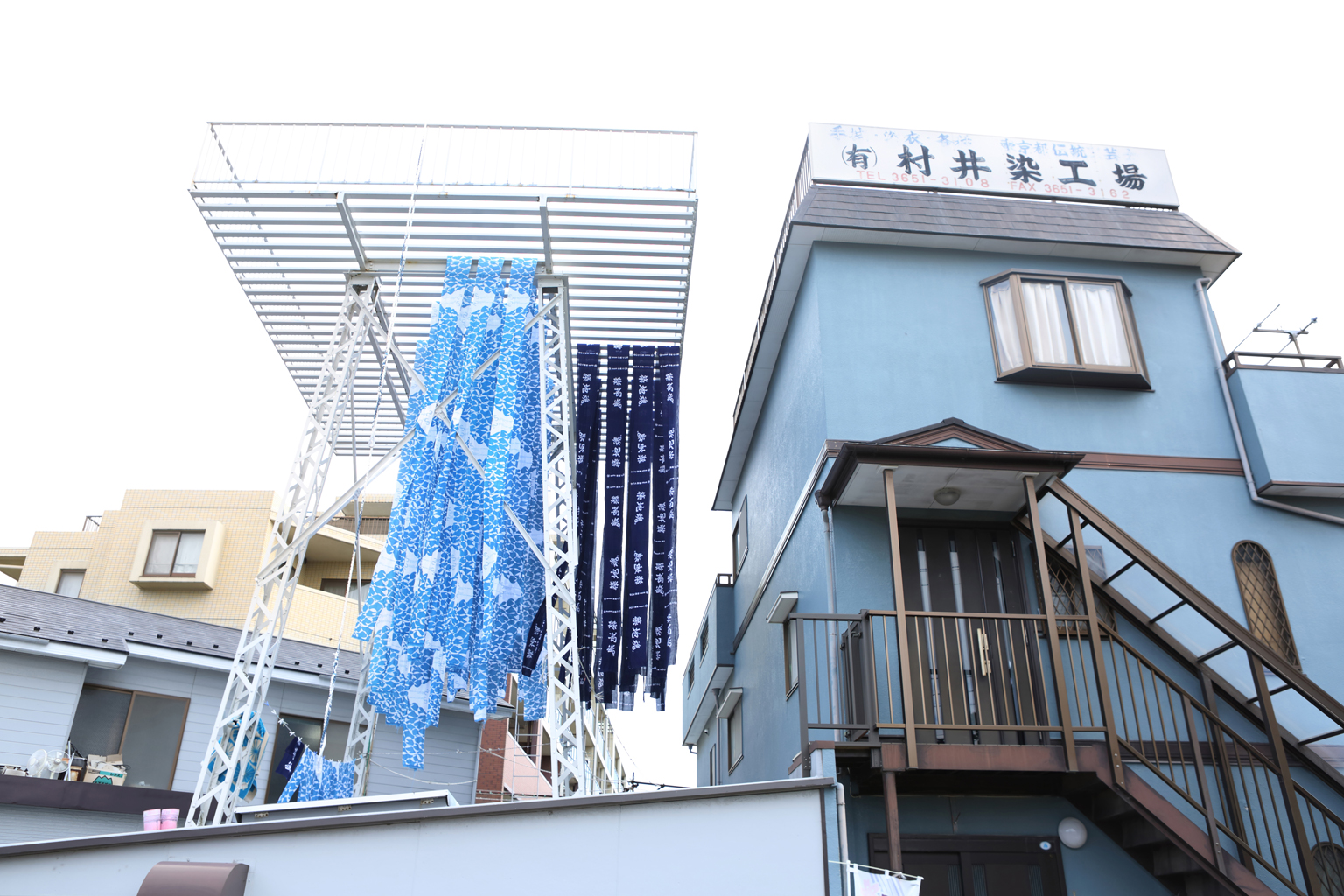
To sun-dry one bolt (about 12 m) of dyed tenugui without leaving creases, a yagura roughly 15 m high has been installed on the rooftop of the two-story dye workshop.
Greeting us was Murai Mitsutoshi, president and third-generation head of Murai Senkoujyo. He joined the family business right after graduating high school and has been at it for more than 40 years. In 2006, he was certified as a Tokyo Traditional Craftsman, a recognition held by highly skilled artisans.
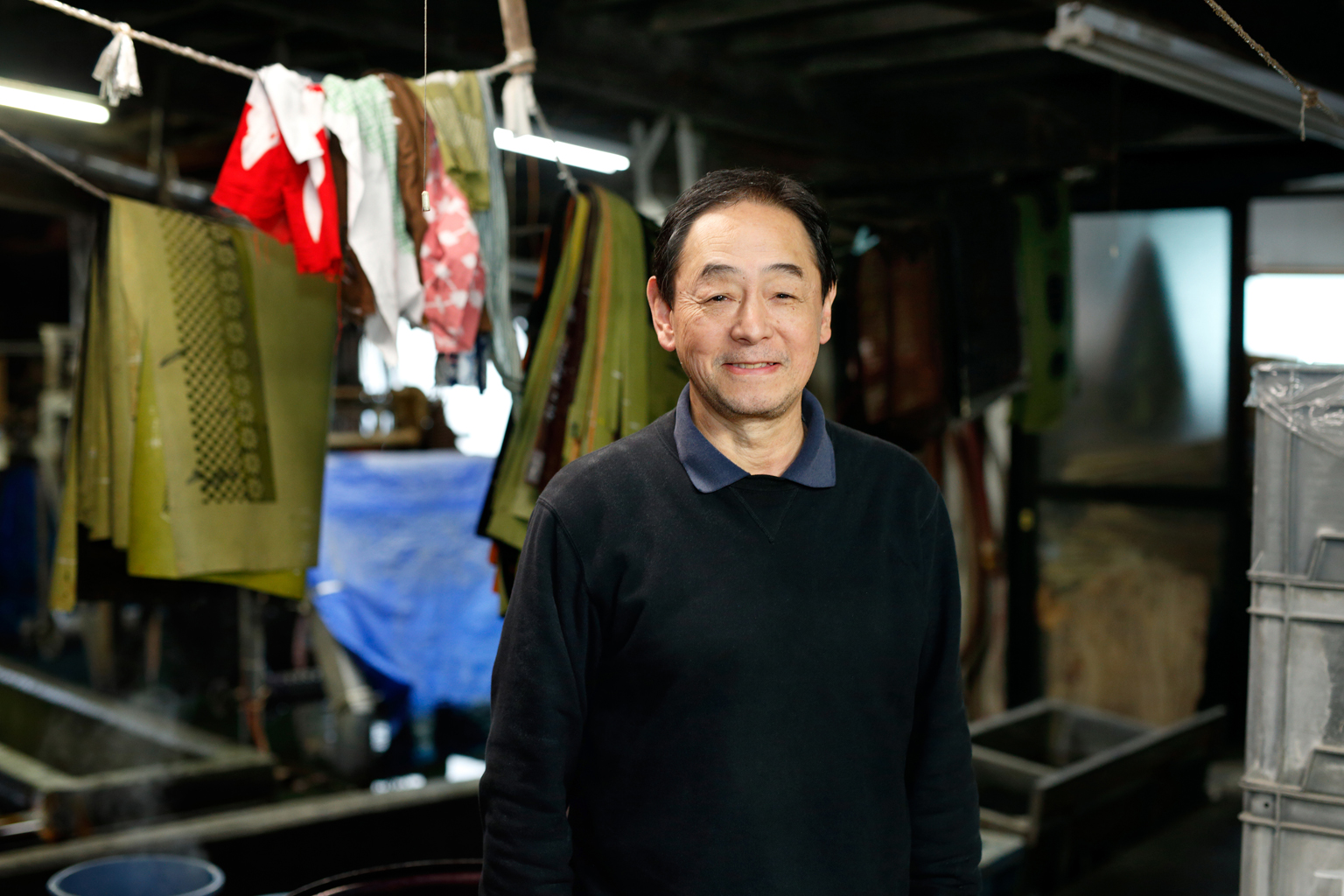
“I was so aware of taking over the family business from a young age that I even wrote ‘I’m going to be a dyer’ in my elementary school graduation booklet,” says Murai.
Founded in 1936, Murai Senkoujyo relocated in 1939 from Higashi-Komatsugawa to its current home in Ichinoe, where it has mainly worked on dyeing tenugui and yukata (summer kimono). Although there were once dozens of dye workshops in the area, today only four remain in Tokyo, and just two in Edogawa City. Even so, Murai Senkoujyo continues to receive a steady stream of orders from across Japan, and it frequently collaborates with companies and organizations.
The traditional technique Murai has continued to uphold is chusen.
“Chusen is, just as the name suggests, a method of dyeing by ‘pouring’ dye. You place a stencil on the fabric, apply resist paste, and then pour dye over it to color the cloth. Because the dye penetrates down to each individual fiber, it produces vivid patterns and colors that look the same on both sides. There are also traditional techniques like sashiwake, where two or more colors are dyed at once, and bokashi, which uses handwork to create overlapping colors and subtle gradations. Unlike printing, where color is layered onto the surface, chusen preserves the natural texture of the fabric—so chusen-dyed tenugui have a supple finish.”
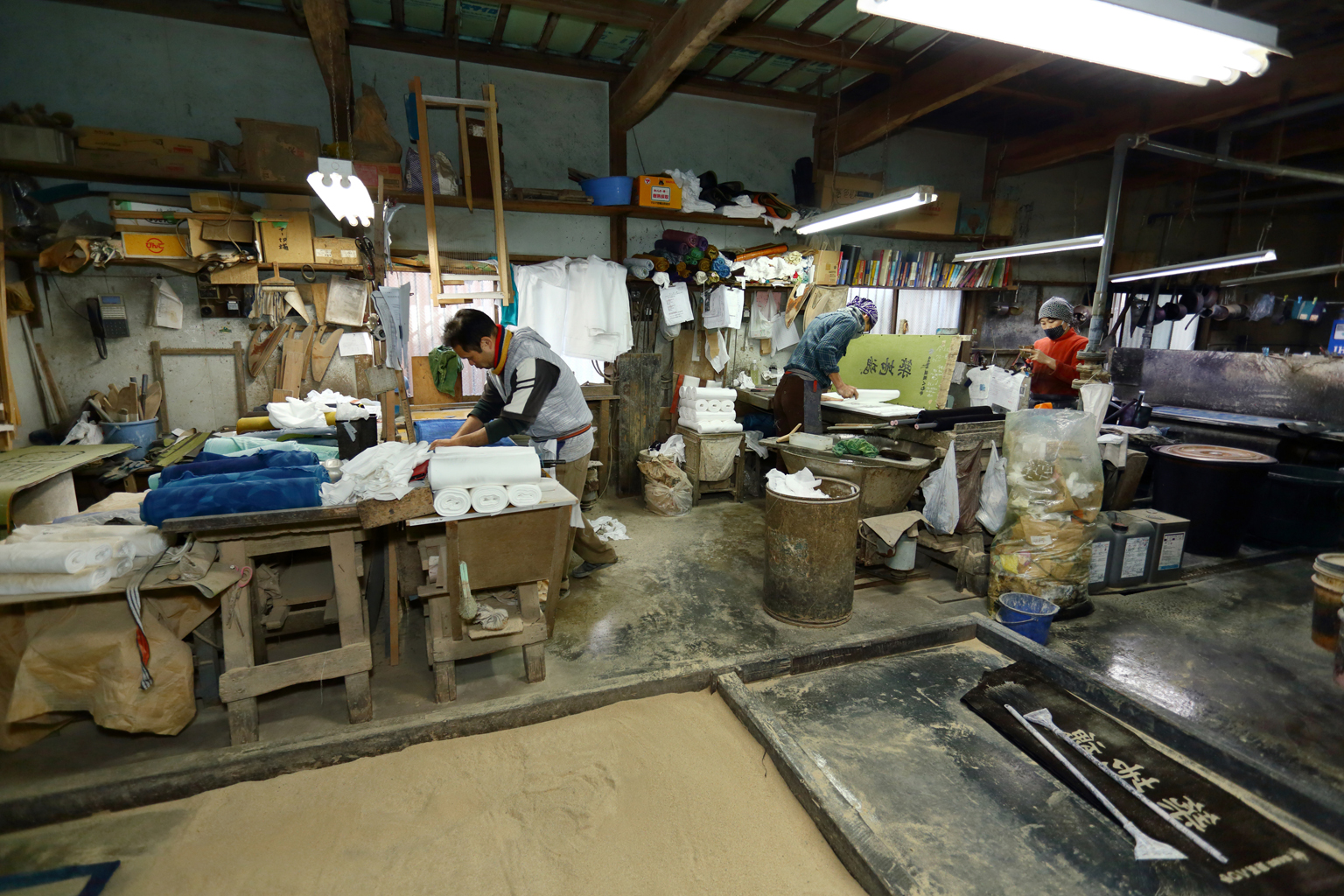
Inside Murai Senkoujyo’s workshop. Nine artisans, ranging from new hires to veterans with 20 years on the job, work on producing tenugui.
From Katatsuke to Dyeing: The Depth of Color Brought Forth by Artisans’ Hands
The tenugui-making process can be broadly divided into four stages. First comes katatsuke, in which a stencil for the design is placed on scoured, prepared white cloth, and resist paste is applied with a spatula. By laying paste on the areas that should not be dyed, those sections remain undyed even when dye is poured over the entire cloth.
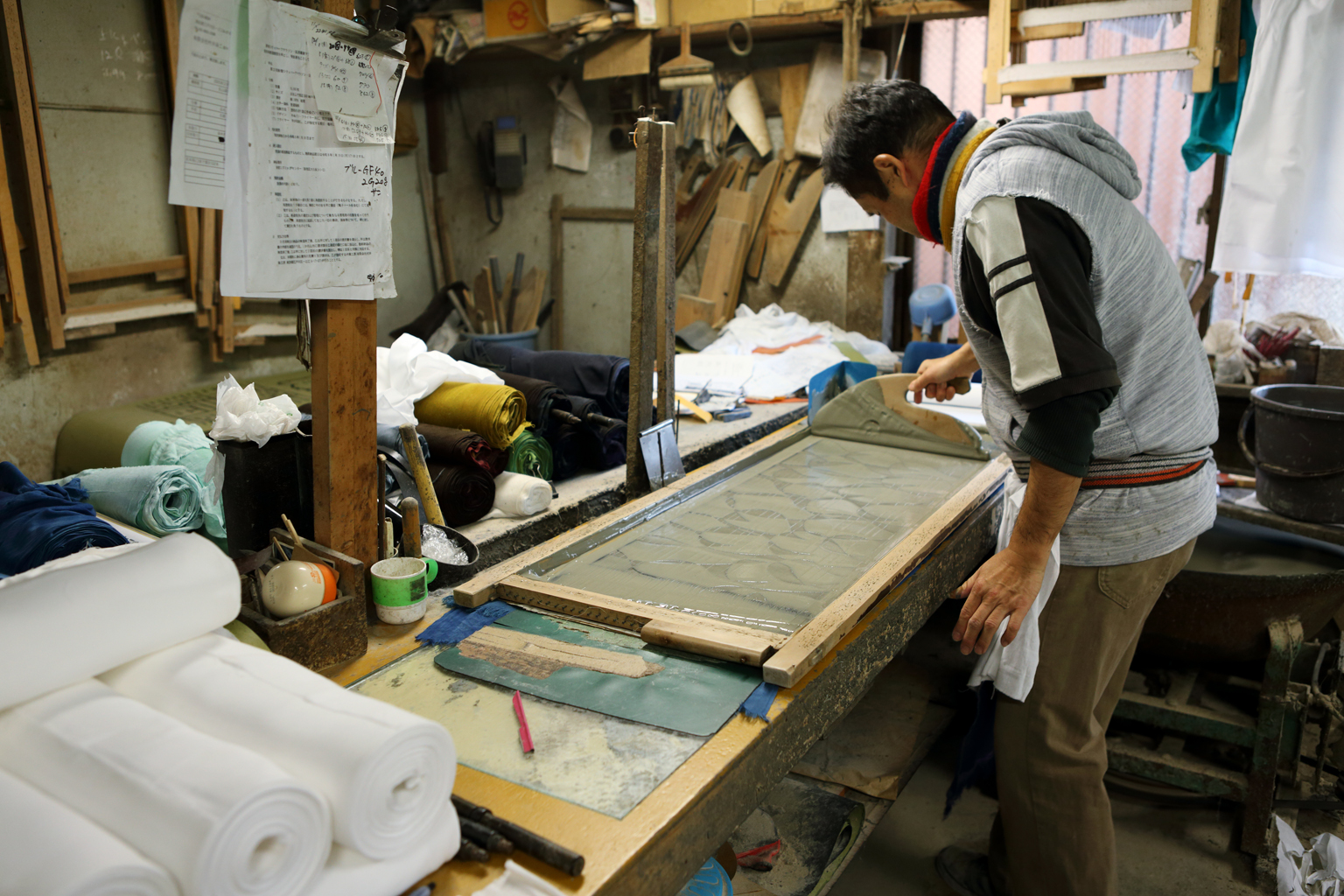
At the stencil-pasting work bench, an artisan uses a wooden spatula to spread paste over the stencil. The delicate touch needed to keep the coating even is something you can only learn with your body.
“If the paste is too soft, the pattern collapses; if it’s too stiff, the outline ends up looking fuzzy,” says Murai. “Adjusting the paste’s water content to suit the season and temperature is also a key part of the job. It takes at least five years to master the basics, and seven to eight years before you can apply it evenly without streaks.”
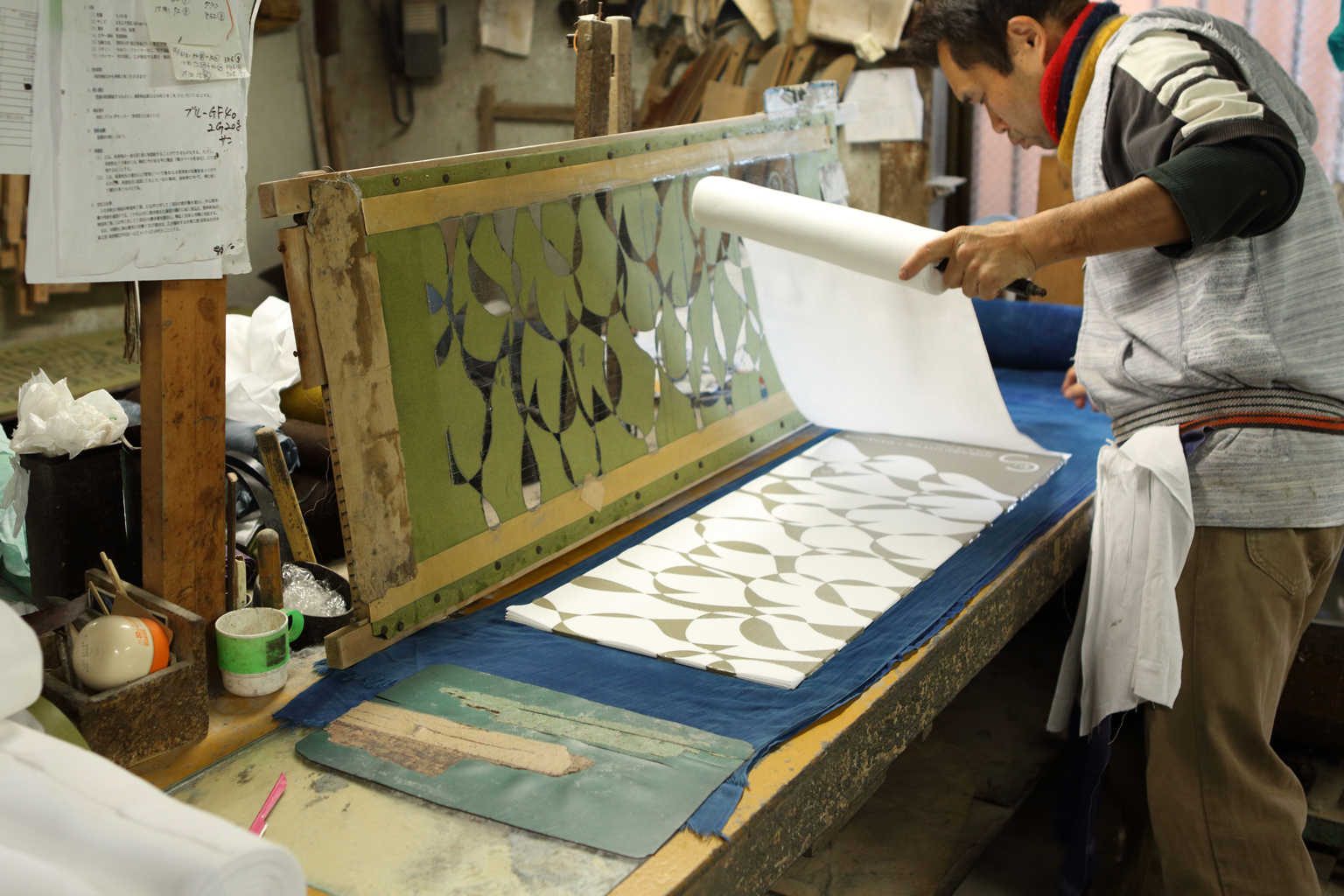
Each time one section is finished, the cloth is folded accordion-style, the stencil is laid down again, and the paste is applied once more. This is repeated, building up the pattern while layering the fabric into many folds.
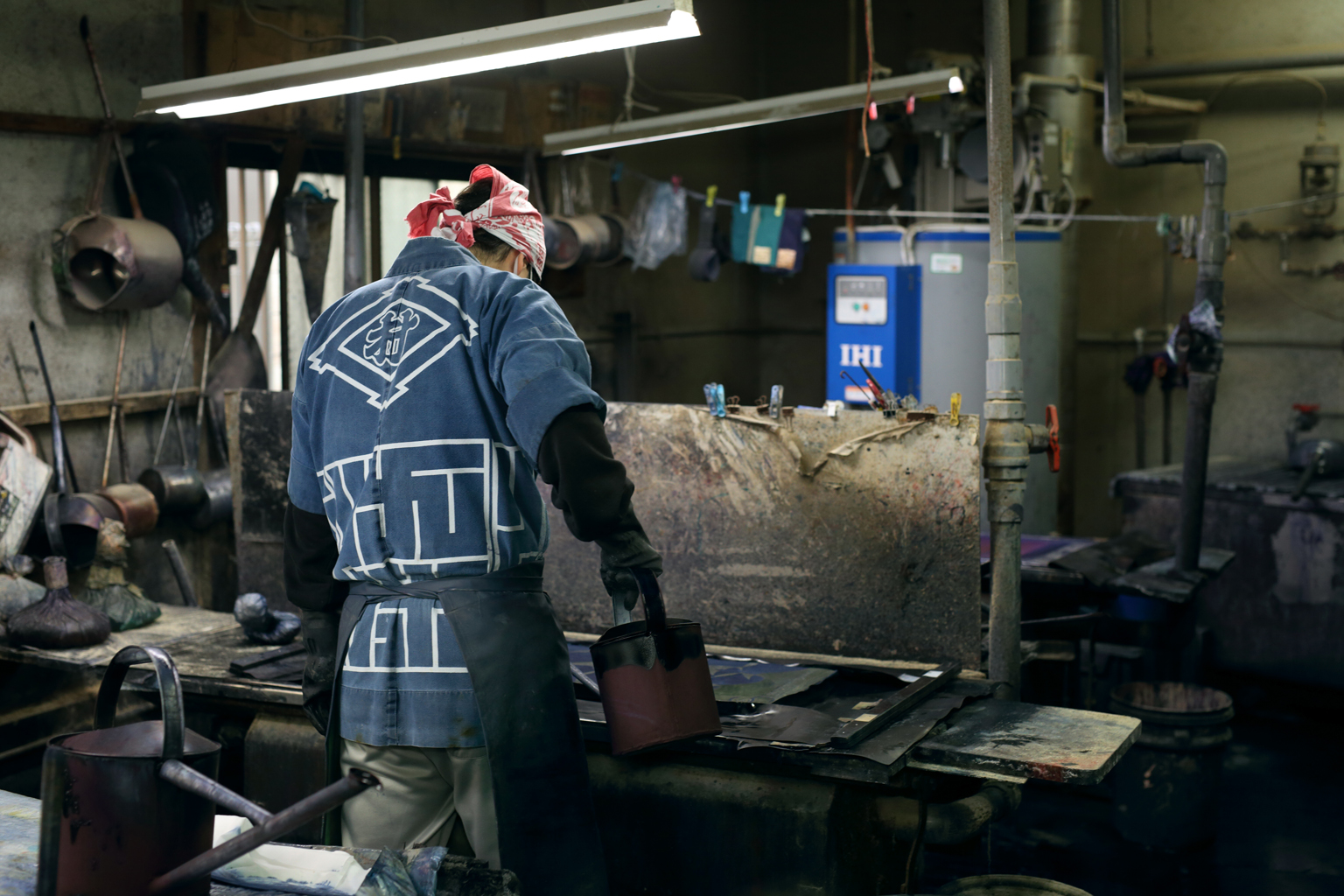
Once the katatsuke process is complete, the work moves on to dyeing. The accordion-folded fabric is set on a chusen dyeing table, and dye is poured using a kettle-like, watering-can tool called a yakan. The dye penetrates everywhere except the resist-pasted areas, and the pattern begins to emerge.
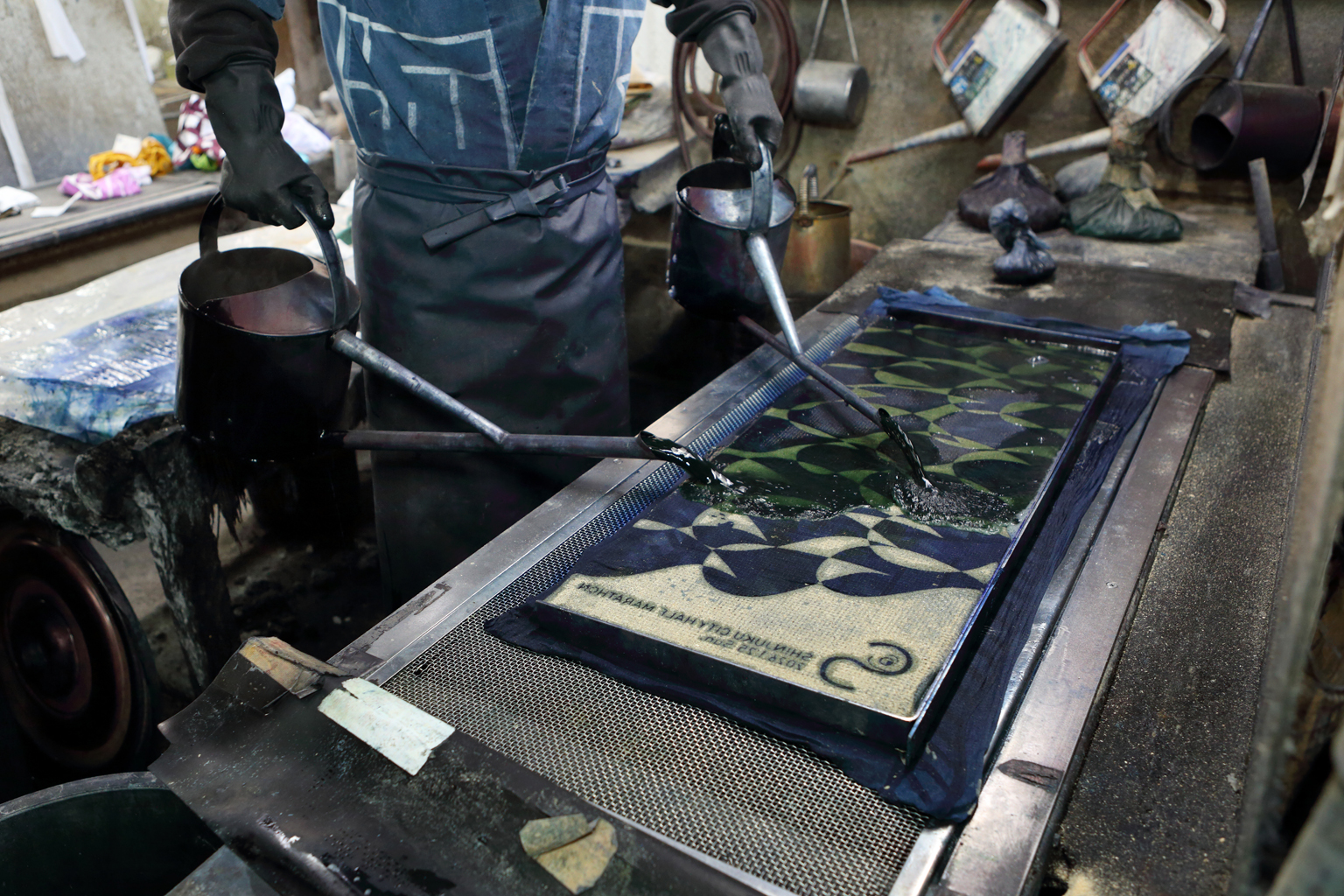
Dyeing work as carried out in a traditional koya workshop. Holding a yakan in each hand, the artisan quickly pours heated dye evenly. Once one side is done, the cloth is flipped and dyed from the reverse side as well.
“Pouring little by little can easily create unevenness, so it takes skill to pour decisively in one go and finish cleanly,” Murai explains. “After pouring the dye, we press the cloth with a tool called a dango, then use a compression machine to suction air from beneath the table and draw the dye through. That extra step is what lets the dye penetrate all the way to the core of the fabric.”
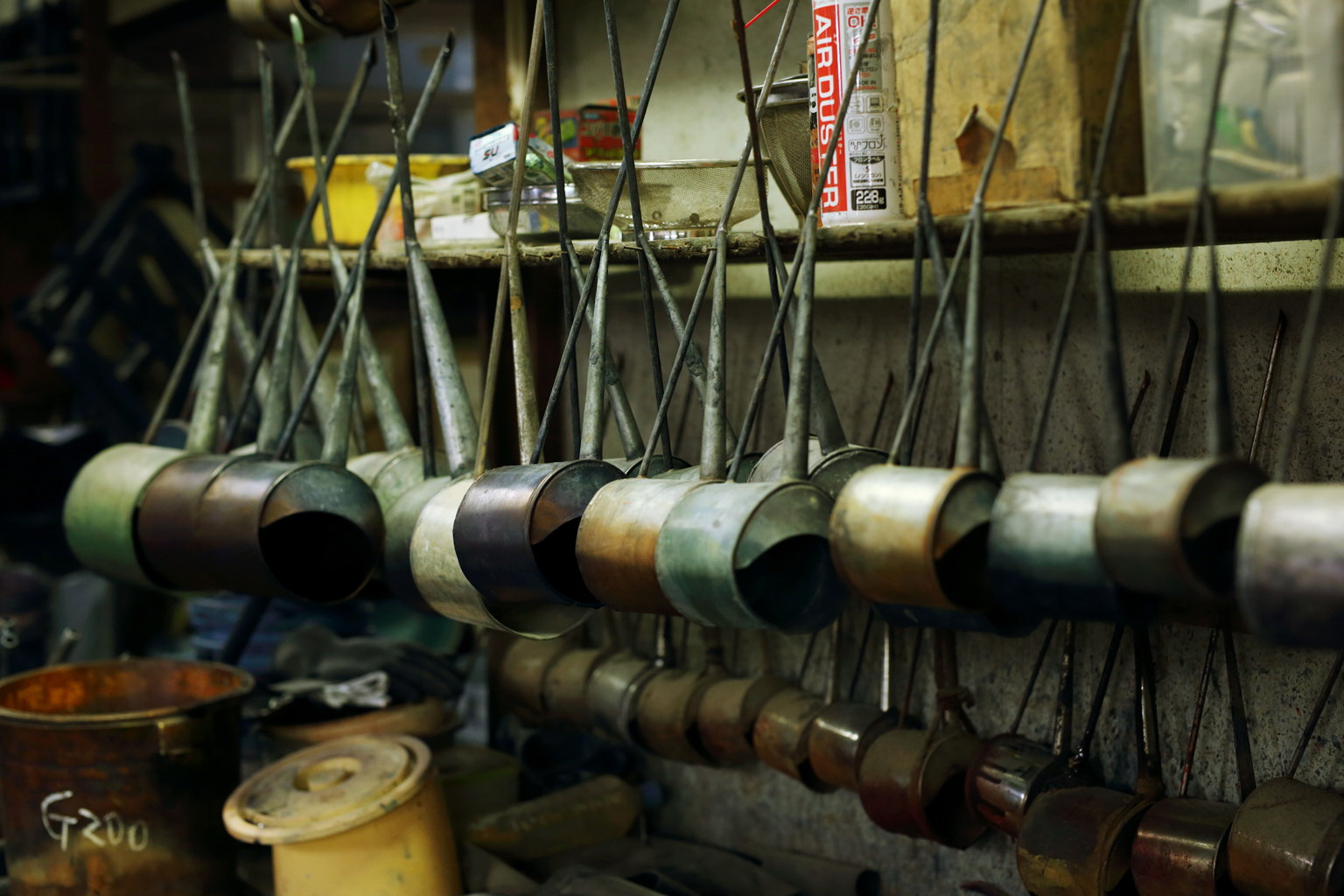
The yakan used for dyeing come in many sizes, with different capacities and spout widths. For large areas, a wide spout is used to pour generously; for fine details, a narrow spout allows more precise pouring.
Tracing Memories of Ichinoe Sakaigawa: Dyeing Traditions and the Role of Water
After dyeing, the fabric moves on to mizumoto, the rinsing stage. It is run through a large washing machine to thoroughly remove excess dye and all remaining resist paste. Murai calls this “an essential step—so important you could say 80% of the product is completed here.”
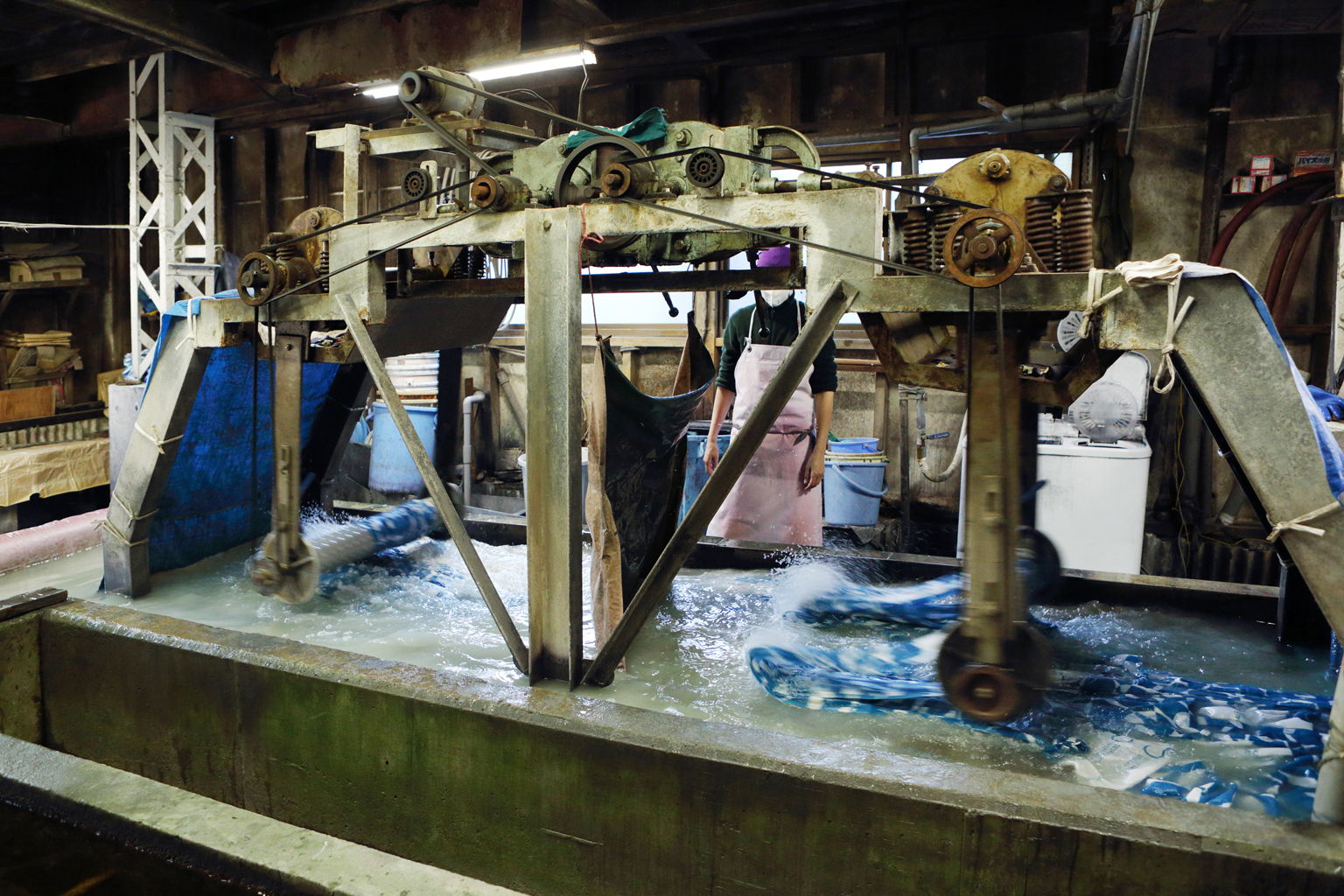
Rollers moving back and forth wash the long fabric as it turns through the machine. About 10 tons of well water are used in a single day.
Once rinsed, the tenugui are spun dry, then hung up to sun-dry on the roughly 15-meter-high yagura towering over the workshop rooftop, as seen at the start of the article. Using a dryer would distort the fabric with heat, so it is dried slowly using natural wind and sunlight for an even finish.
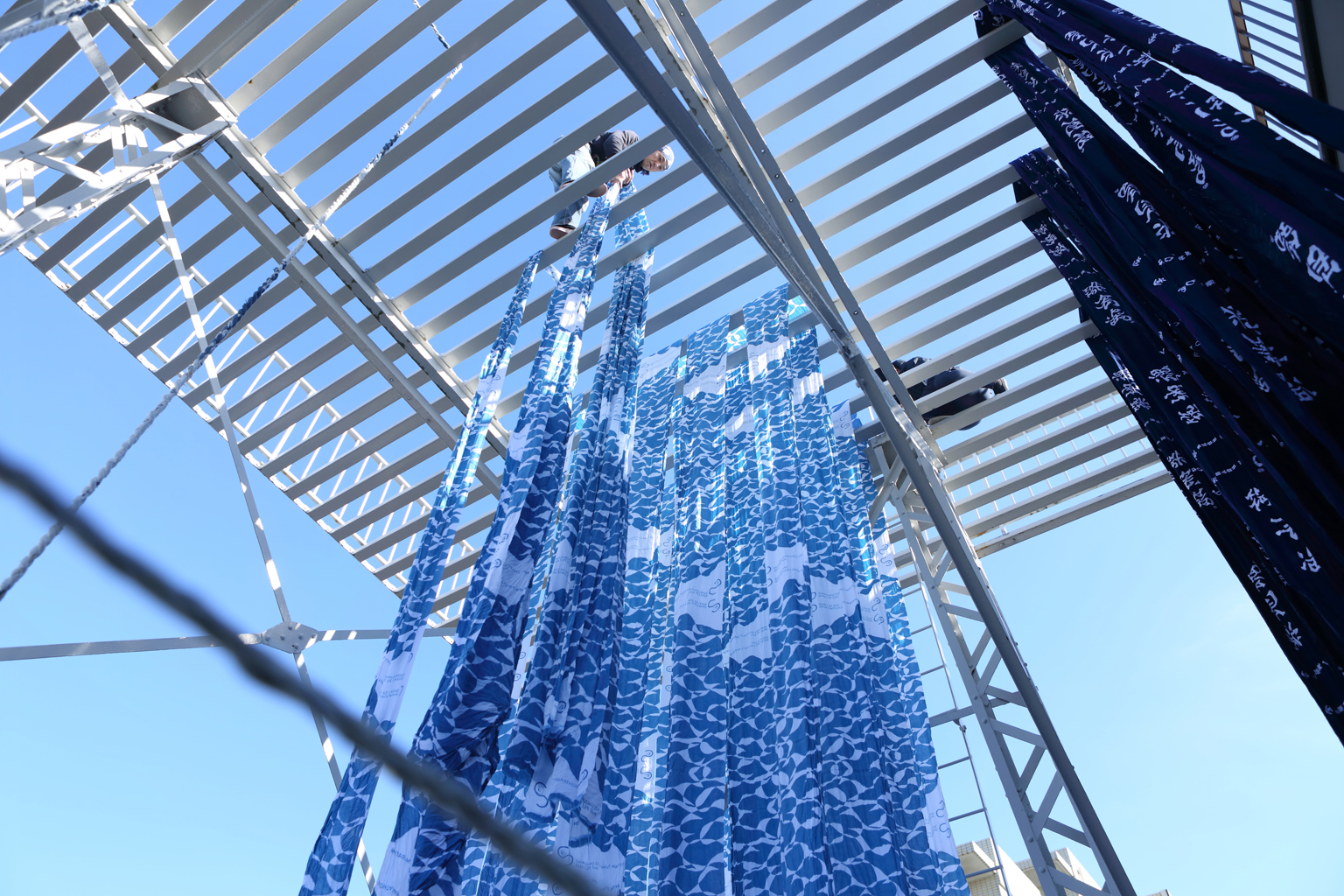
An artisan climbs the tall yagura and hangs the wet fabric while smoothing it so no unnecessary creases form. Sun-drying the cloth as it hangs naturally under its own weight preserves the soft feel unique to hand dyeing.
When dry, the fabric is fed through a dedicated rolling machine to remove wrinkles and neatly align the weave. Finally, it is cut to a set size, completing a single tenugui.
Supporting this long sequence of dyeing, washing, and drying over many years has been the area’s abundant water.
“I was born in 1962,” Murai says. “Back then, around the dye workshops there were fields and lotus ponds—it was a quiet, rural landscape. I’m told that artisans would hang tenugui on bamboo poles and rinse them by shaking them in the Ichinoe Sakaigawa River that flowed right in front of the workshop. Today the river has been developed as Ichinoe Sakaigawa Shinsui Park, so rinsing has moved inside the workshop—but we still wash using well water that draws on Edogawa City’s abundant water sources.”
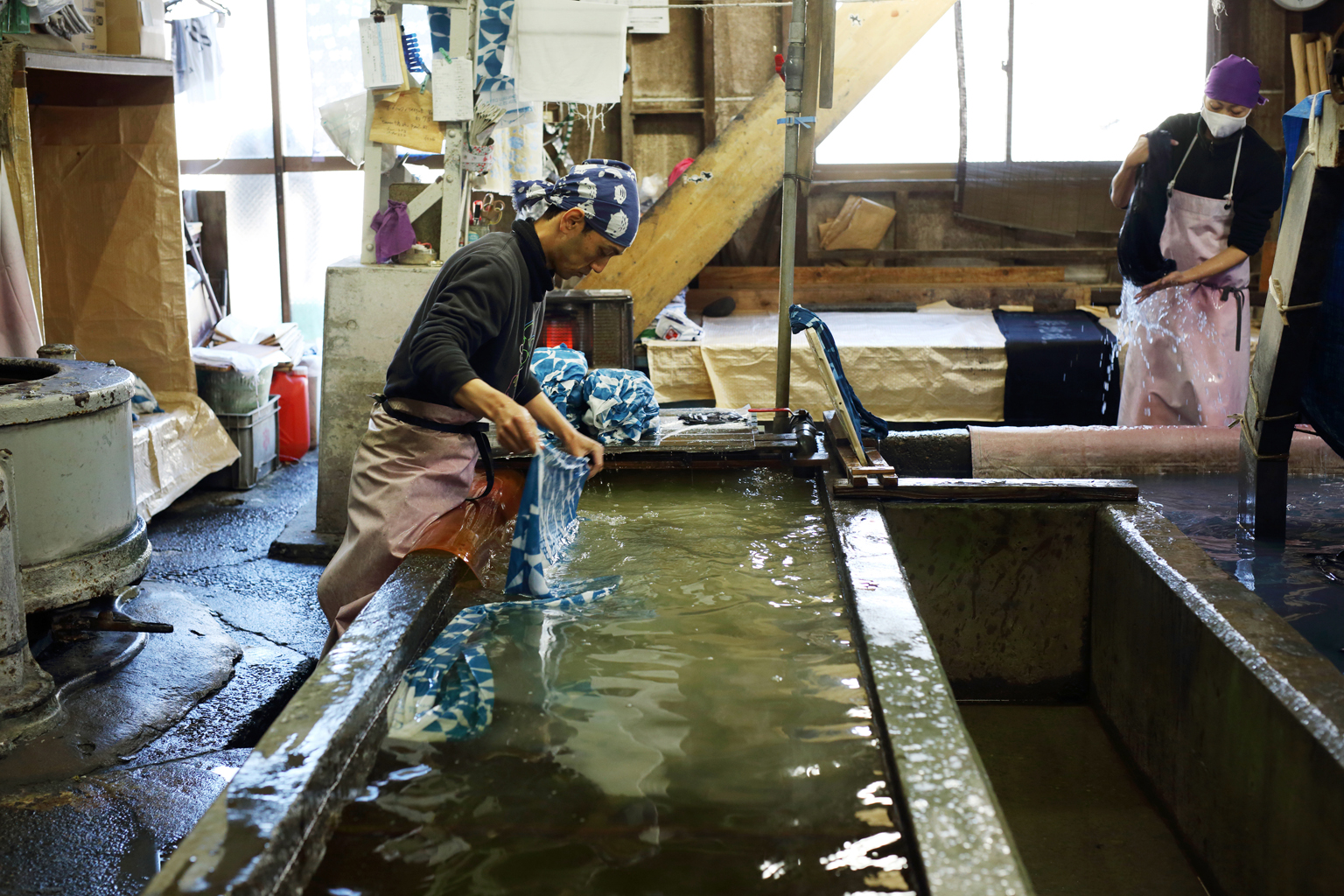
Sometimes paste and dye are washed out entirely by hand, without machines. Hot water can’t be used because it could cause the fabric to shrink, so even in midwinter the washing is done in cold water.
So much so that, depending on the dye, they may even switch between well water and tap water—the quality of the water affects both color development and how well the dye sets. The surrounding streetscape has changed dramatically, but Edogawa City’s rich water resources continue to support the chusen work of Murai Senkoujyo to this day.
Expanding Tenugui’s Possibilities: A New Generation Carries the Craft Forward
Today, nine artisans work at Murai Senkoujyo. Even in an age of increasing mechanization, the workshop maintains an entirely hand-crafted production system, turning out around 1,400 tenugui per day in normal periods, and as many as 1,600 per day during peak season. In October 2023, the chusen technique was also designated a national Traditional Craft Product under the name Tokyo Honzome Chusen.
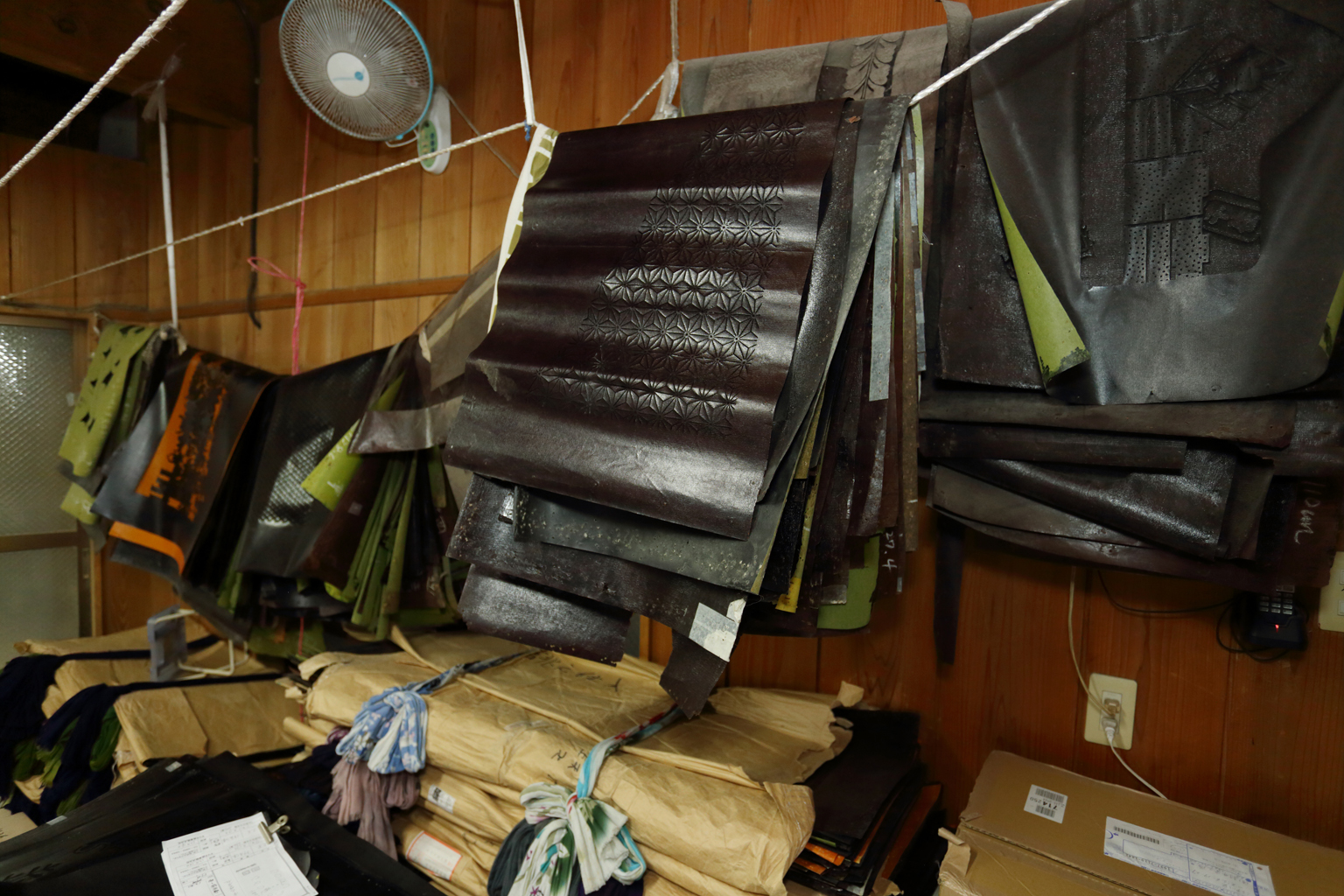
There are as many stencils as there are orders from across Japan. In the past, stencils made by laminating washi paper and hardening it with persimmon tannin—known as Ise katagami—were the standard. But as the number of craftspeople has declined, stencils made from laminated paper infused with resin are now also used.
“During the COVID-19 pandemic, festivals and events were canceled, and demand for tenugui dropped sharply. We went through a period when we could only run the workshop two or three days a week,” Murai says. “But once restrictions were eased in 2023, demand came roaring back, and now, if anything, we’re busier than before. A major reason is the rise in inbound tourism.”
Thin, quick-drying, and usable on both sides, chosen-dyed tenugui have gained popularity among overseas visitors as a practical souvenir that feels distinctly Japanese. As a result, the factory now receives an even wider variety of orders than before. Alongside traditional Japanese patterns, more contemporary designs featuring cats, Mt. Fuji, and more have increased, further expanding the expressive range of chusen.
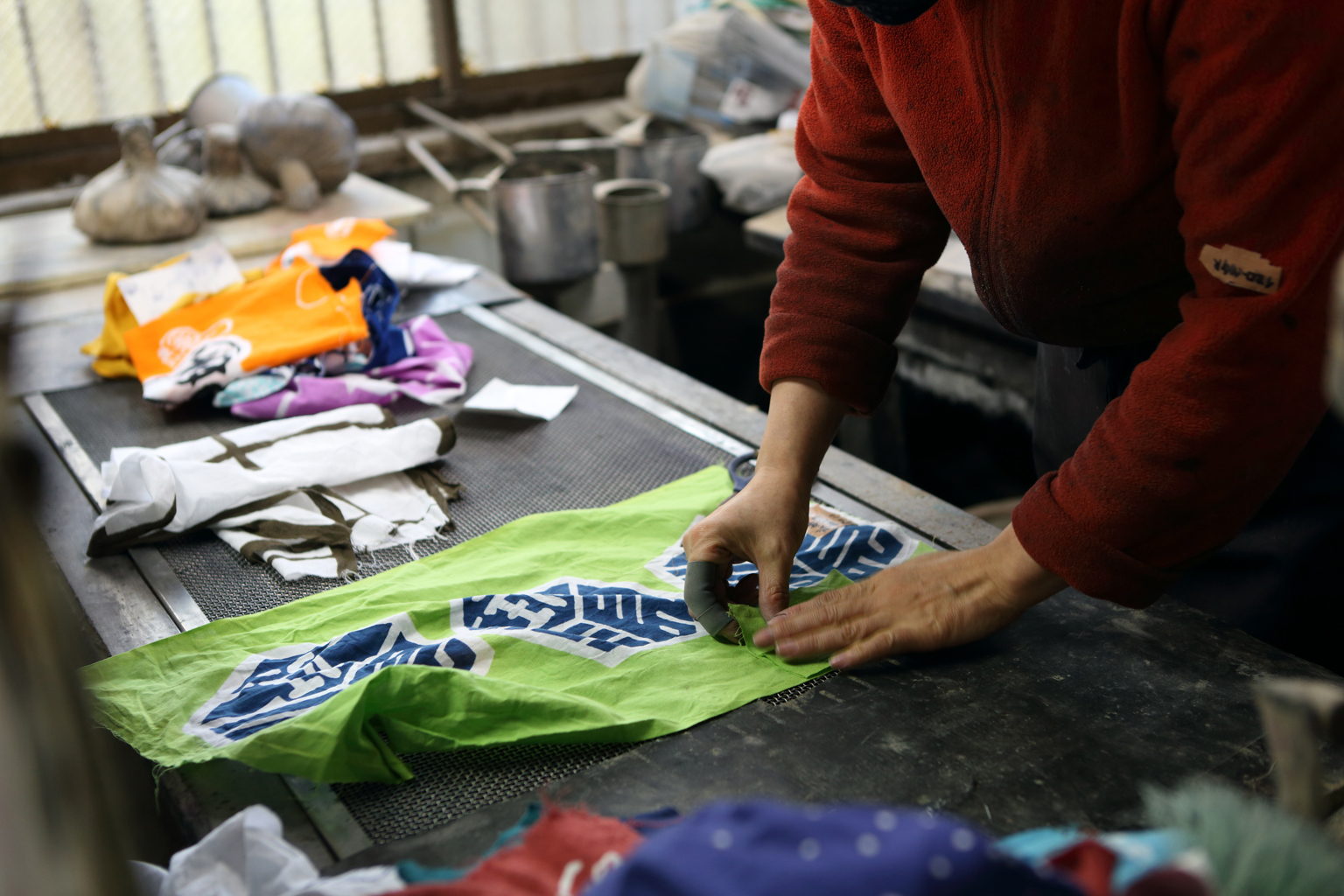
The tenugui Murai Senkoujyo has produced vary widely in both color and design. Every tenugui ever made on order is kept on hand as a sample, so it can be referenced at any time.
Even as chusen-dyed tenugui grow more popular, there are challenges to sustaining the craft. Tools and materials, including resist paste, have become harder to obtain as makers age or close their businesses.
“Securing the white cloth that forms the base of tenugui is getting harder every year,” Murai says. “There are fewer mills that weave the fabric, and the sarashiya—the specialists who bleach woven cloth white—are also dwindling nationwide. Some are moving toward using imported white fabric, but the texture inevitably differs. This is a critical issue that the chusen association as a whole needs to address going forward.”
How to pass the tradition to the next generation is a challenge—but there is also hope. In recent years, as chusen has become more widely known through events and social media, more young people than before are aspiring to become artisans. Several younger craftspeople joined Murai Senkoujyo after participating in initiatives held jointly with Edogawa City, such as the Chusen Practical Workshop and the Artisan Workshop, which were created to address a shortage of skilled workers.
“Some come from art schools, others are career-changers—people’s backgrounds vary,” Murai says. “But what they share is a strong desire to dye tenugui. Because they’re motivated, they pick up skills quickly. We even have artisans who mastered in three years what would normally take five. In recent years, more women have been applying, and we now have three women artisans working here. It seems other dye workshops are also seeing more young people—this is no longer an era where ‘artisan’ means only older folks.”
Murai’s second son, Kai, is part of that trend. Now 31, he decided while still in university that he would take over the family business, and joined Murai Senkoujyo immediately after graduating. Today he is an essential member of the team, entrusted with a broad range of work from katatsuke through dyeing.
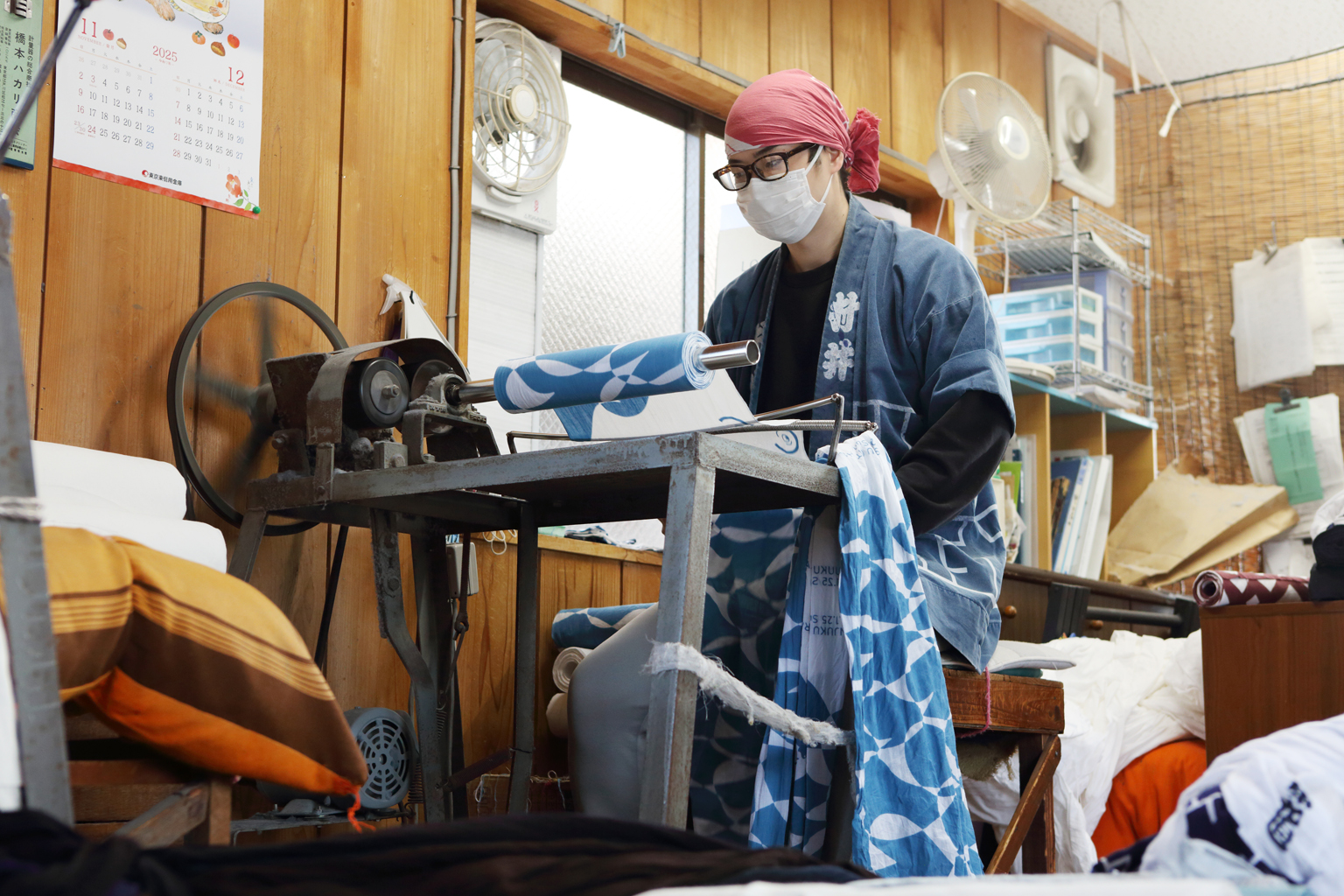
Murai Kai winds tenugui on a fabric rolling machine. By pulling the cloth with both hands at just the right tension as he rolls it, he smooths out the wrinkles left from sun-drying.
“I thought Murai Senkoujyo might end with my generation, so I never expected someone would carry it on,” Murai says with a smile. “I’m happy. Chusen is a technique you won’t find anywhere else in the world—it exists only in Japan. I want to keep passing on what we inherited from those who came before us.”
From the days when tenugui were washed in the Ichinoe Sakaigawa River, Edogawa’s dyeing trade has moved forward alongside water. Now, strengthened by younger hands, its tradition courses steadily into a new era.
Writing: Kiuchi Aki
Photo: Takeshita Akiko
Introduction of the Artisan
Founded in 1936 in Higashi-Komatsugawa, Murai Senkoujyo relocated to Ichinoe, Edogawa City, in 1939. Since then, the workshop has continued dyeing tenugui using the chusen technique across three generations. It is currently led by third-generation owner Murai Mitsutoshi (63), a Tokyo Traditional Craftsman, and produces around 2,900 tan (approx.. 35,000 m, or 30,000 tenugui) per month together with a team of nine artisans. While safeguarding tradition, the workshop also focuses on training the next generation.
・Murai Senkoujyo
・6-17-27 Ichinoe, Edogawa City, Tokyo