Edogawa Craft Stories

[Edo Inden] 68 Years of Leather Craftsmanship: A Masterful Showcase of Inden Bags and Accessories
In a quiet residential neighborhood of Matsumoto, Edogawa City, stands the workshop of Sanko Corporation. At the workbench is artisan Tada Tsukasa, who continues to make leather goods such as bags and wallets using the traditional craft of inden—patterns applied to deerskin with lacquer. Having worked with leather for 68 years since the age of 15, Tada’s products—born of distinctive skill and ideas, such as patchwork made from a wide range of komon-patterned leather pieces—are delivered from Edogawa City to customers across Japan.
Edo Sanko Inden: Traditional Patterns Reimagined with Originality
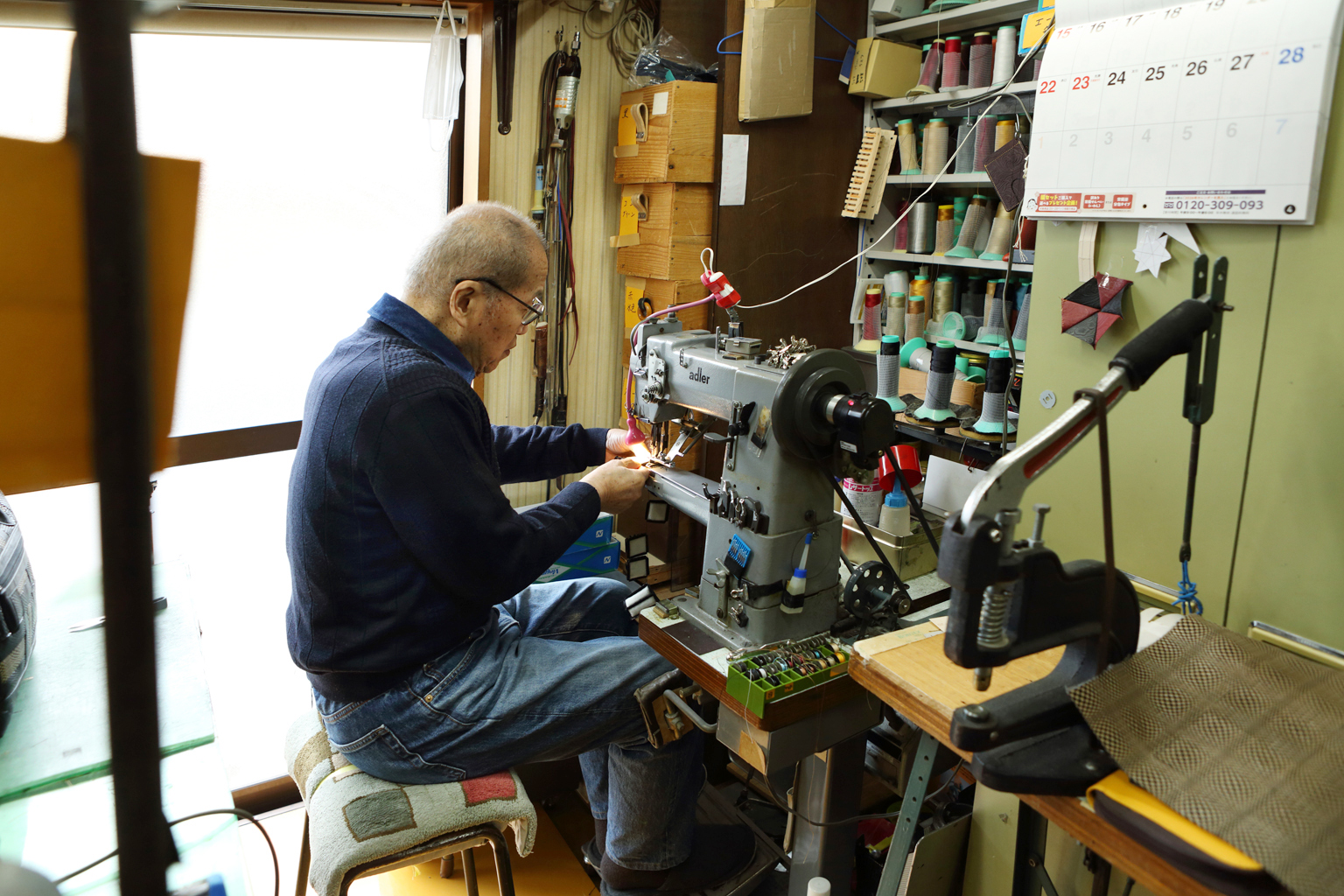
Stepping into the workshop, you are met with the rich, deep scent unique to leather goods. Along the wall, boxes of sewing thread are neatly organized by color number, stacked all the way up near the ceiling. Nearby, several types of sewing machines are lined up for different stitching purposes, including a German-made Adler machine.
“This one is already 50 years old, but that one is still only about 40, I think? I take good care of them, so they still run great,” says Tada Tsukasa, representative director of Sanko, with a smile. A seasoned artisan, he sits before his trusted machines day after day, sewing leather.
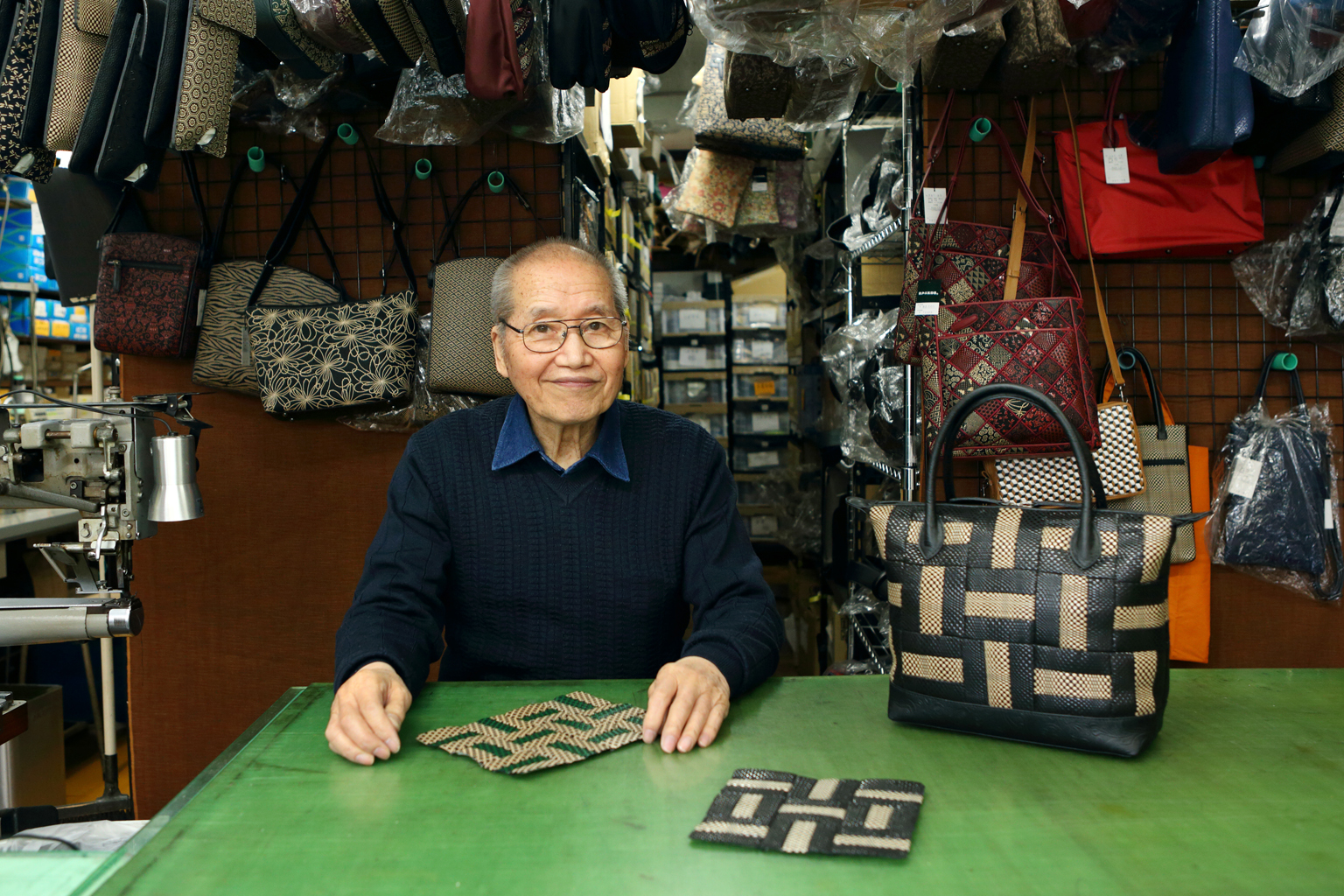
Tada, representative director of Sanko, who spoke with us. The workshop is lined with bags and leather accessories, from design through sewing, all made in-house.
Sanko’s signature works are the bags and leather accessories in its Edo Sanko Inden series, created using the traditional Japanese leather craft of inden, in which patterns are applied to deerskin with lacquer. The history of inden is long, and it is widely known as a traditional craft originating in Koshu (present-day Yamanashi Prefecture). Yet Edo Sanko Inden has evolved in its own distinct way through Tada’s craftsmanship and ideas.
One example is their “corded patchwork inden,” a delicate technique in which komon-patterned pieces of inden deerskin are arranged in a carefully planned layout, then stitched together on a sewing machine with a flat cord inserted along each seam. The roots of this technique trace back to the days when Tada entered the world of leather artisans as a 15-year-old.
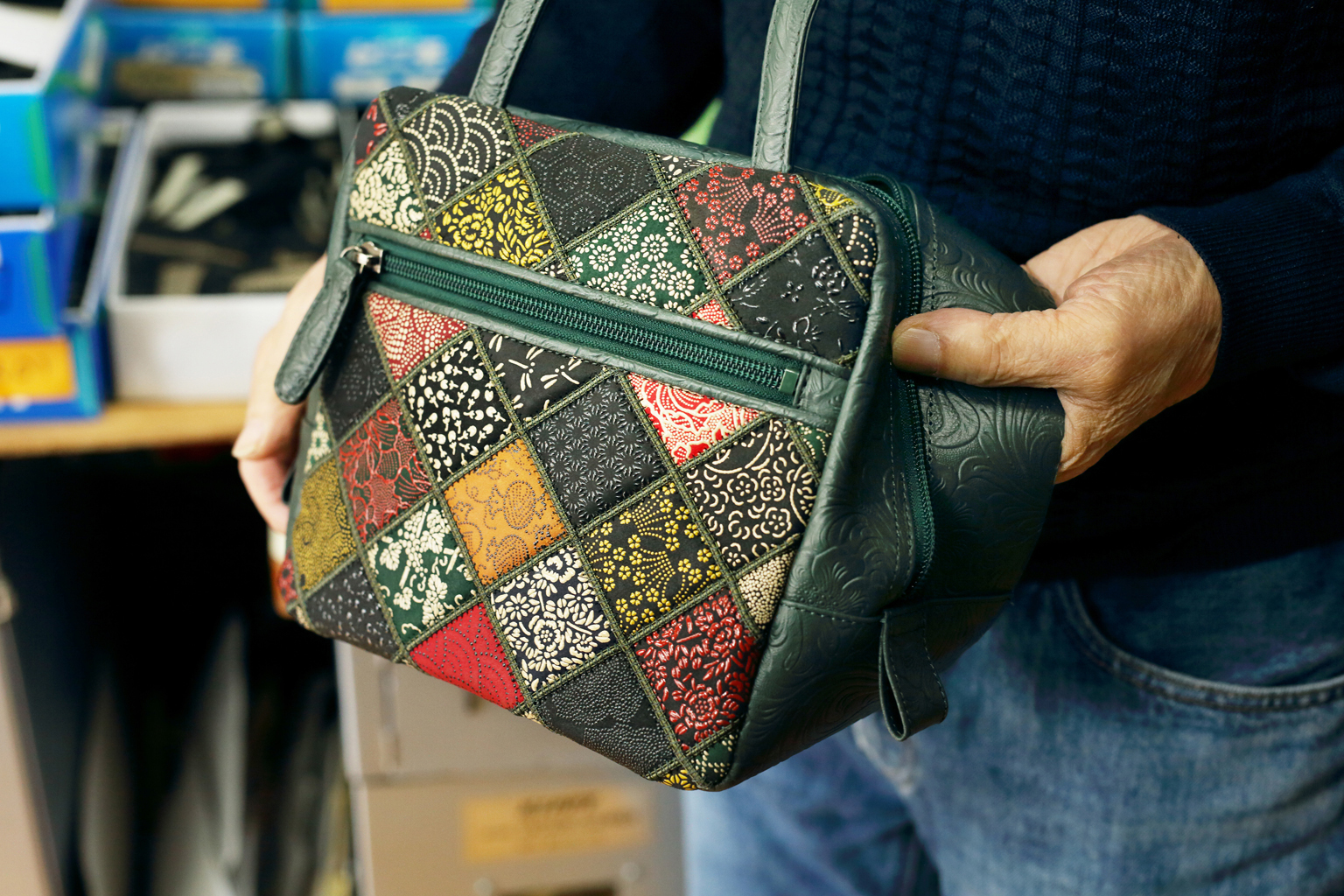
A corded patchwork inden Boston bag in production at the time of the interview. Its luxurious construction—bringing together numerous different komon patterns across the surface—has become a flagship item that only Sanko can create.
From Skills Honed Since 15 to the Encounter with Inden
In 1958, just after graduating from junior high school, Tada decided to become an artisan—a decision prompted by a single remark from his uncle.
“My uncle ran a handbag wholesale business in Osaka, and he told me, ‘If you hate studying, become an artisan,’ and introduced me to a place to train. I’m from Awaji Island, and I grew up running all over the mountains and rivers, so I never imagined I’d be doing seated work from 8 a.m. to 10 p.m. I wanted to run away within a week (laughs).”
As he struggled with his unfamiliar new life in Osaka, young Tada quickly set a personal goal to go independent within 10 years. Driven by that resolve, he would pull out his master’s patterns late at night after everyone had gone to sleep, and commit their structures to memory, sheet by sheet. He also volunteered to take on repairs for bags that were brought in, deepening his learning from other companies’ ingenuity and unique approaches.
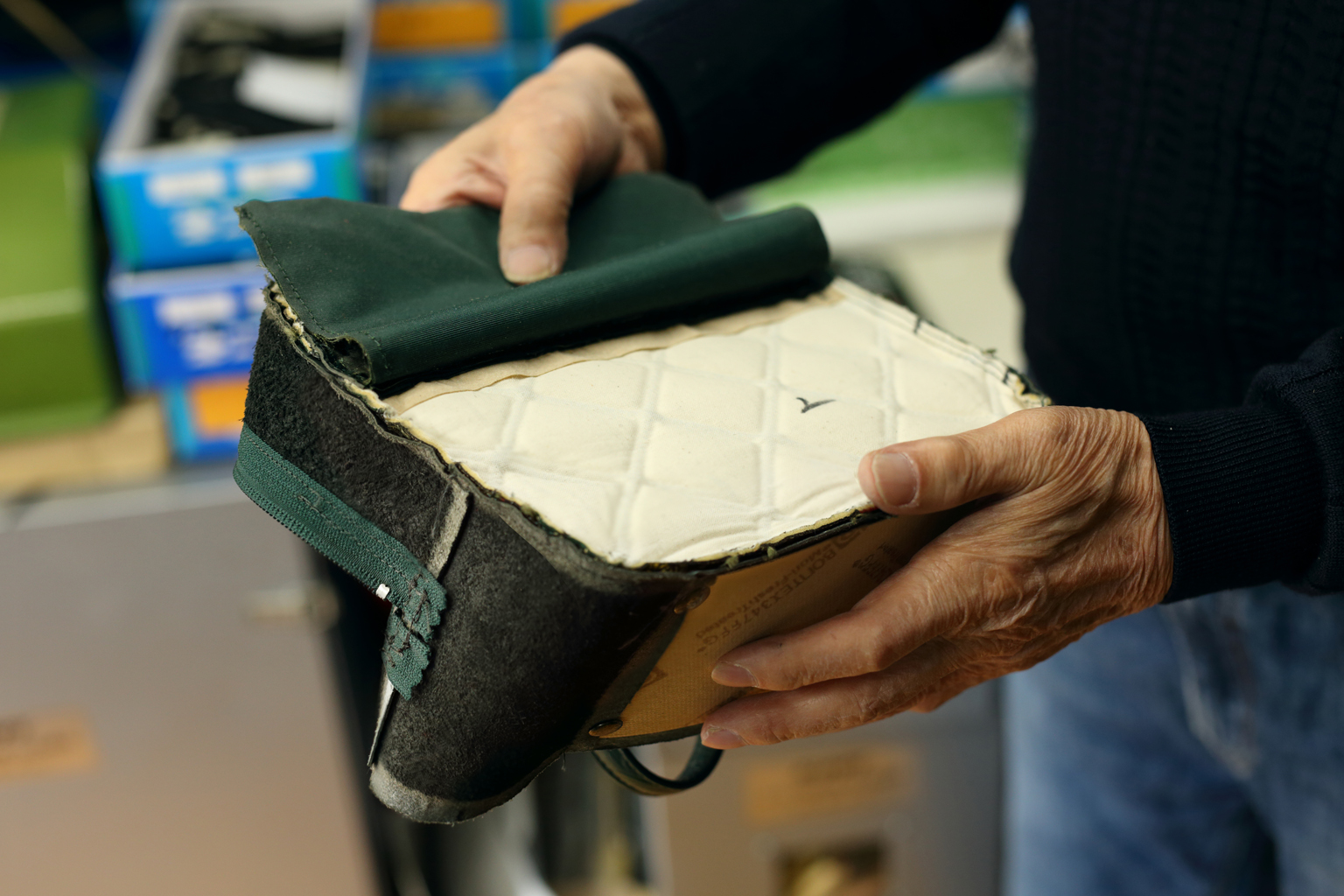
“You can see bag designs if you go to a store, but you can’t tell how they’re structured inside. When I was young, doing lots of repairs and learning how things were ‘built’ gave me more tools in my creative toolbox,” says Tada.
Then one day, during market research at a department store on his day off, Tada’s attention was caught by a leather product: a crocodile-skin bag that was extremely expensive, yet selling well.
“I wanted to learn that technique, so I was introduced to a company in Tokyo specializing in reptile leather, and I moved there at 21. That’s where I learned a technique called tsunagihagi—joining pieces together. Working with reptile leather requires delicate joining skills unlike those used for large-area cowhide. I trained intensively for four and a half years, and at 25, I achieved my goal and went independent.”
But just five years later, in 1973, the Washington Convention was adopted, and reptiles were added to regulated categories. With his supply route cut off, Tada began searching for a new path—and eventually started handling contract production for brand-name bags. Business went well, and in 1986 he founded Sanko. Meeting the strict demands of major brands further elevated his technical skills as an artisan.
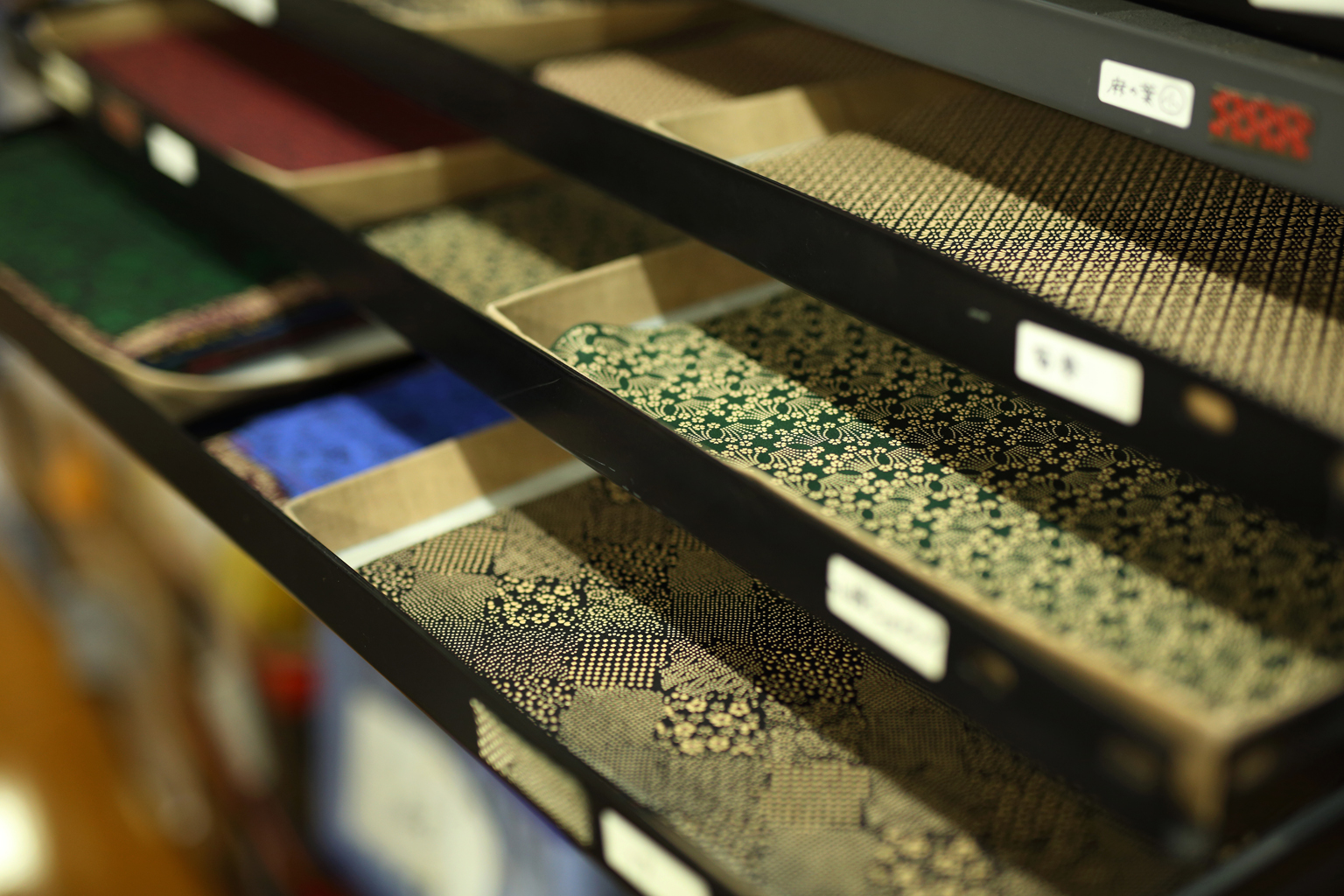
Inden leather in the workshop. Alongside pieces featuring traditional komon patterns are others with modern, Western-style motifs, showcasing a wide variety of colors and designs.
Around that same time, a trusted vendor asked him if he could make inden bags. Tada recalls that when he first held inden leather in his hands, he felt his excitement rise as he thought how easy it looked to work with.
“Crocodile leather back then had these rugged bumps, and it was really hard. Compared to the days when I was sewing that, the deerskin used for inden is extremely supple—very easy to handle. And on top of that, I was deeply drawn to the depth of this material that uses lacquer unique to Japan. You know, when an artisan encounters good materials, it makes your heart dance—and that alone changes the finish.”
The Beauty of Patchwork: Meticulously Joining Leather Pieces
At Sanko, Tada handles everything in-house, from thinking up bag designs and drafting patterns to sewing and finishing. Patchwork inden, one of the company’s flagship products, begins with cutting the inden leather. A cutting die is set on the leather, and the press machine applies firm pressure. With a sharp sound in an instant, the deerskin is punched out.
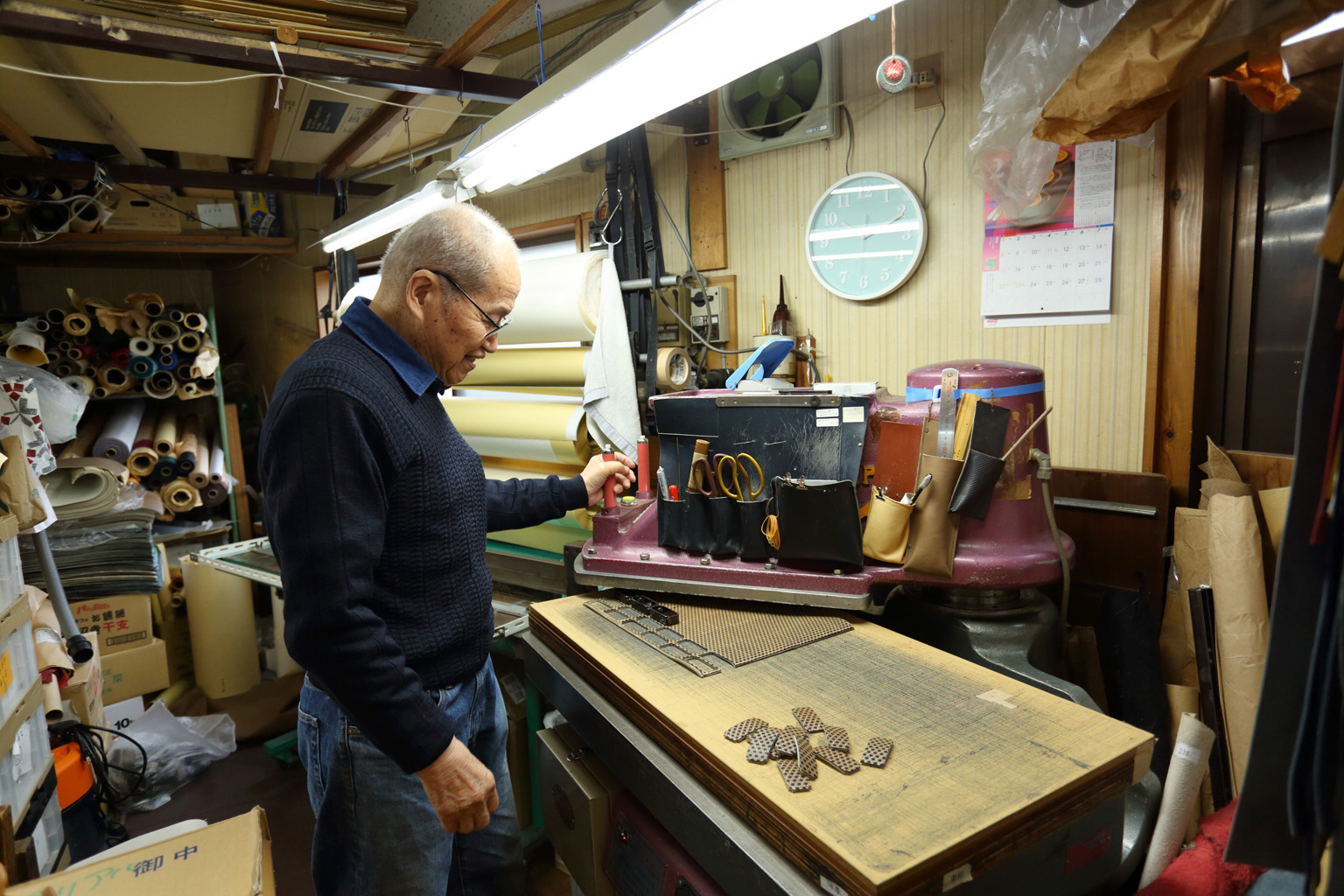
A custom-made Swedish steel cutting die is placed on the leather, and pressure is applied with a dedicated press machine. The punched-out pieces are then joined together as patchwork.
After cutting, the pieces move to koba-suki—skiving the edges with a leather skiving machine to thin them. If the edges remain thick, the finish will be affected when the leather is joined.
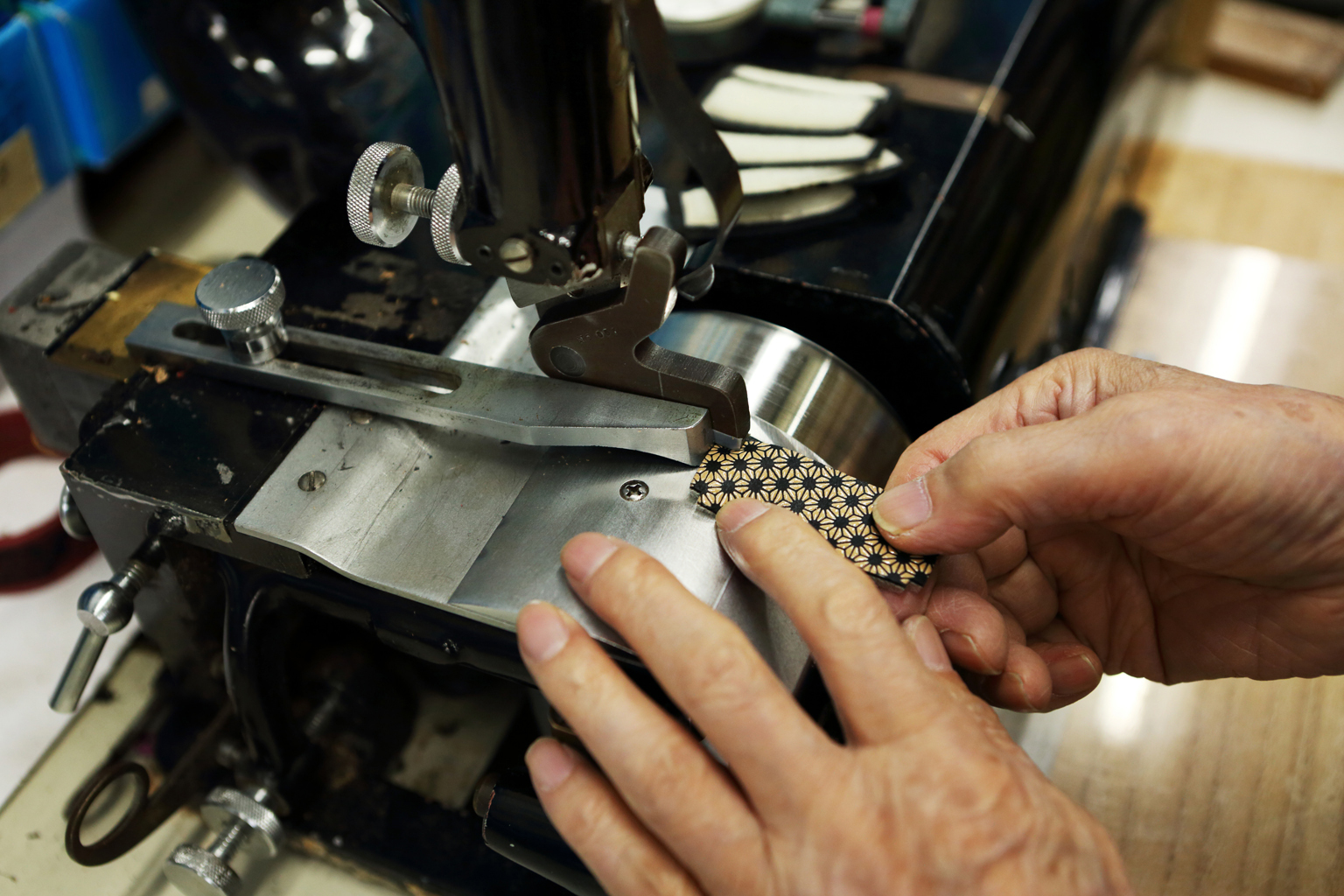
Koba-suki involves shaving away the leather edge with a rotating blade so overlapped areas do not become bulky. This extra step makes sewing easier, flattens the seams, and creates a cleaner silhouette.
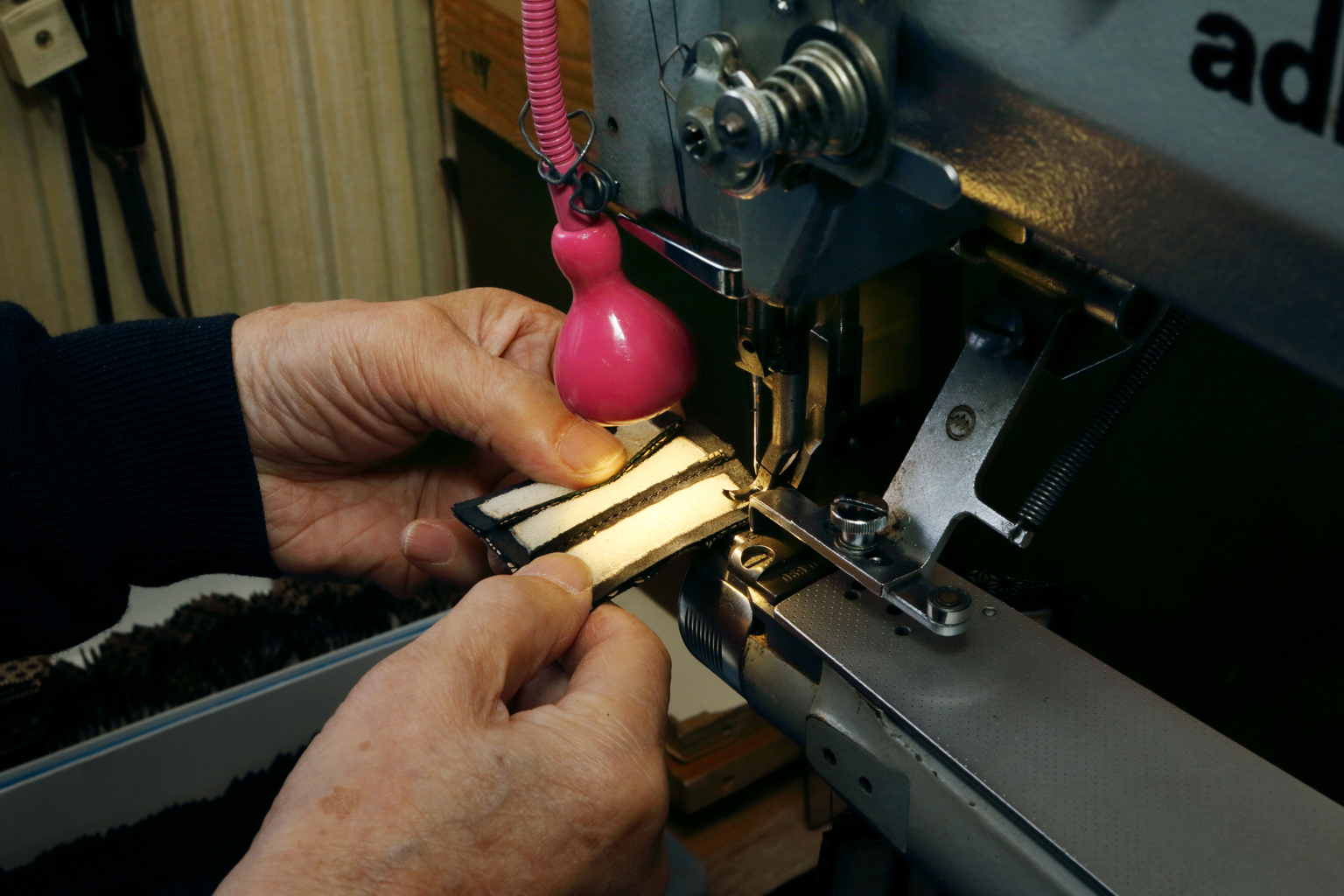
After skiving, the pieces are sewn together with a cushioned core material to create parts, which are then stitched together one by one on a sewing machine.
For corded patchwork inden, Tada’s daughter, Yumiko, prepares the base. She cuts out fusible interfacing with adhesive according to the product size and carefully adheres each piece in place.
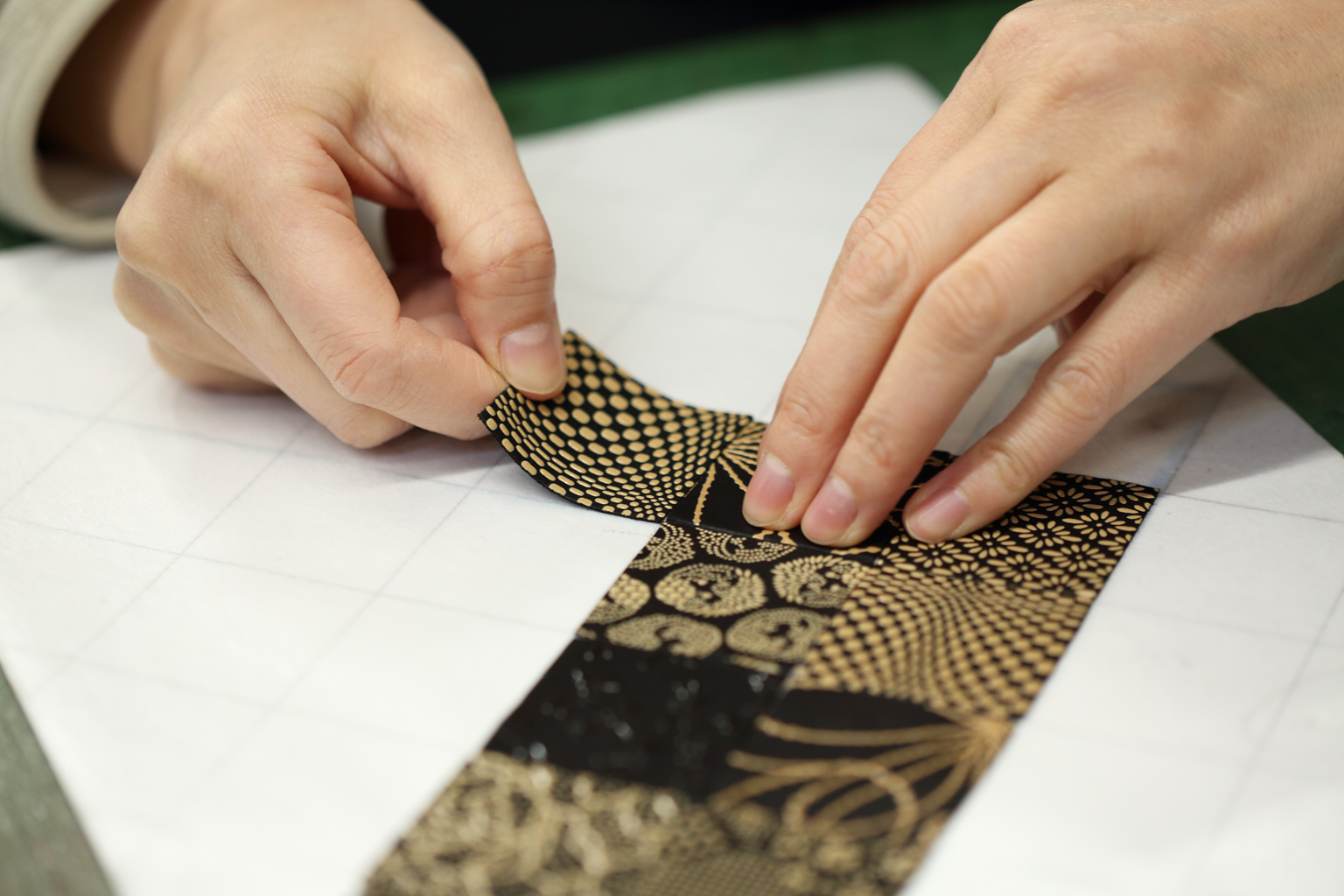
Each piece is laid out one by one, paying attention to color balance and placement so that the same pattern does not end up side by side.
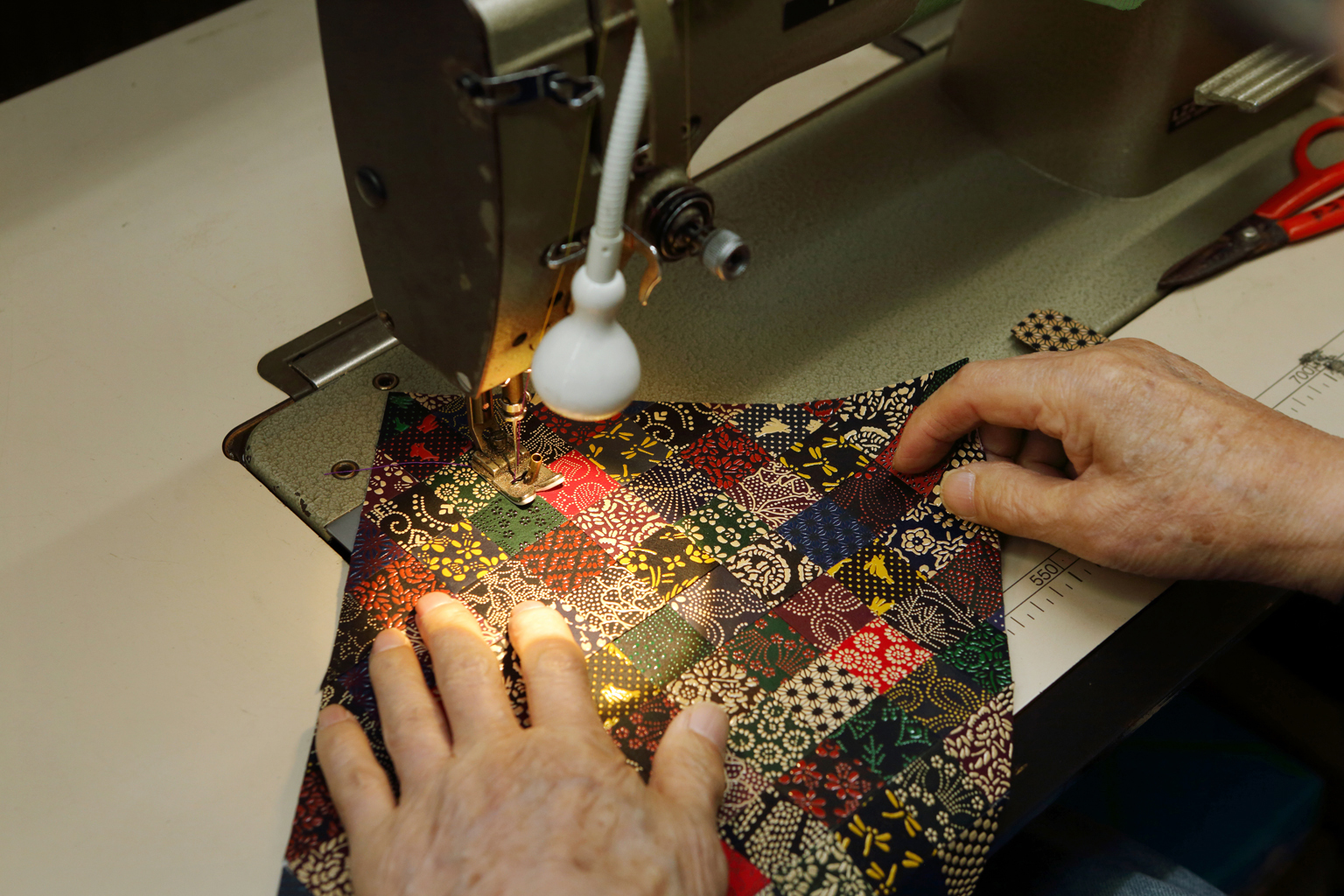
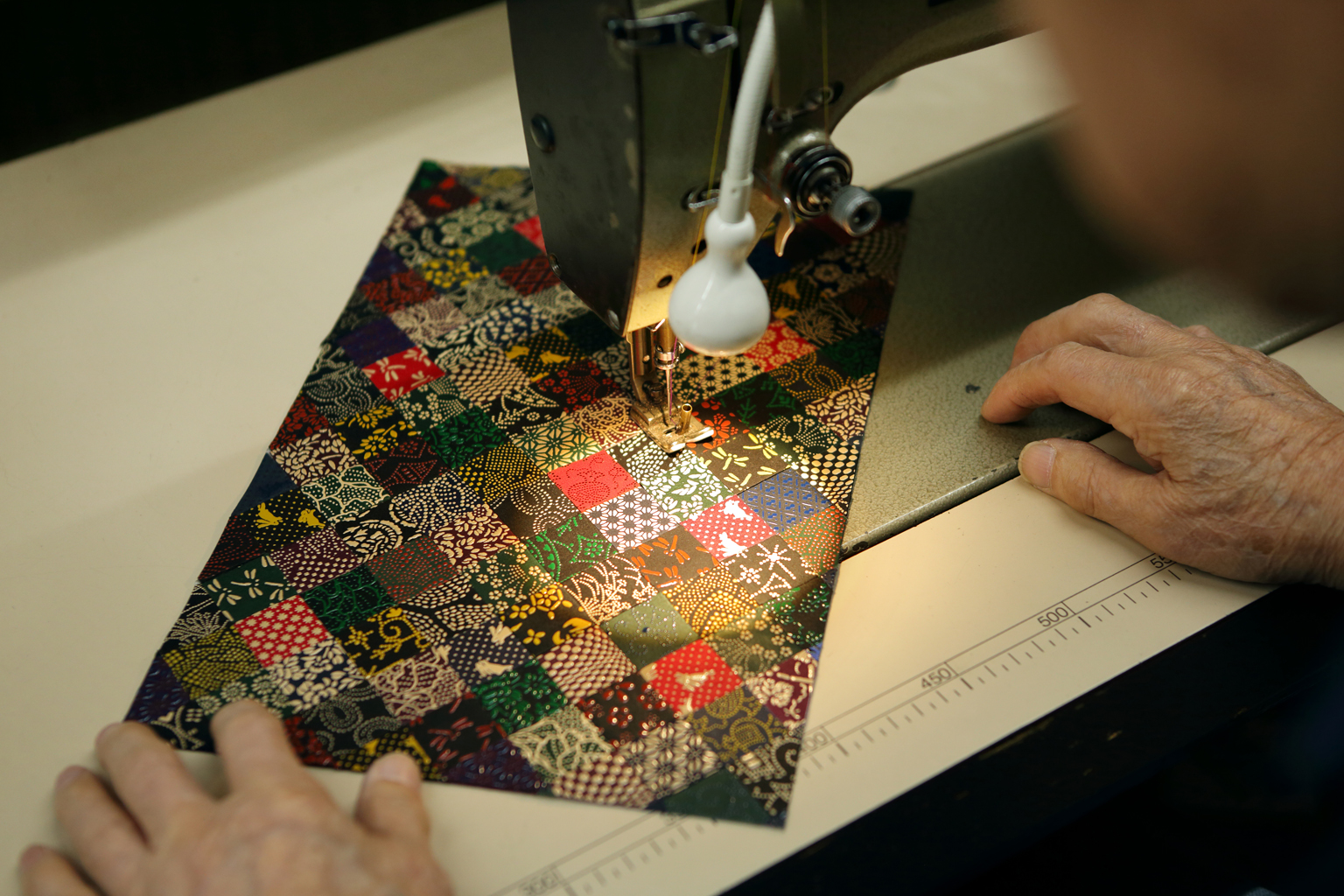
Once the layout is complete, Tada sits down at the sewing machine and stitches zigzags along the patchwork seams while placing a flat cord over them. It is a device that stabilizes the sewing while also serving as a design accent that brings out the product’s individuality. The value of Sanko’s products is created through the steady accumulation of careful processes, without sparing effort.
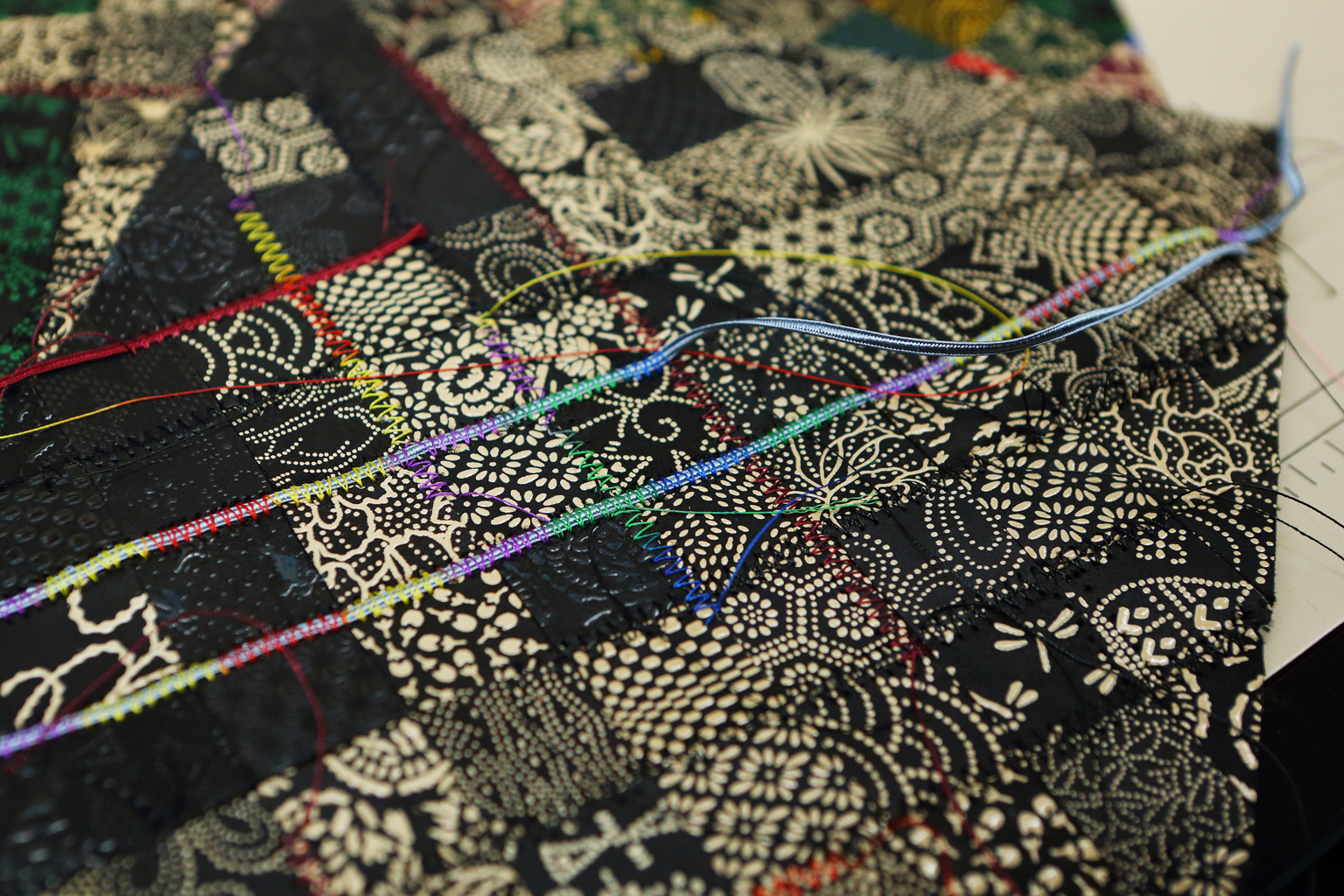
We were shown a demonstration using a sample patchwork piece. The flat cord is laid into the gaps between pieces and stitched down from above, firmly linking the leather pieces together. The overall expression of the design also changes depending on the color combinations of the cord and thread.
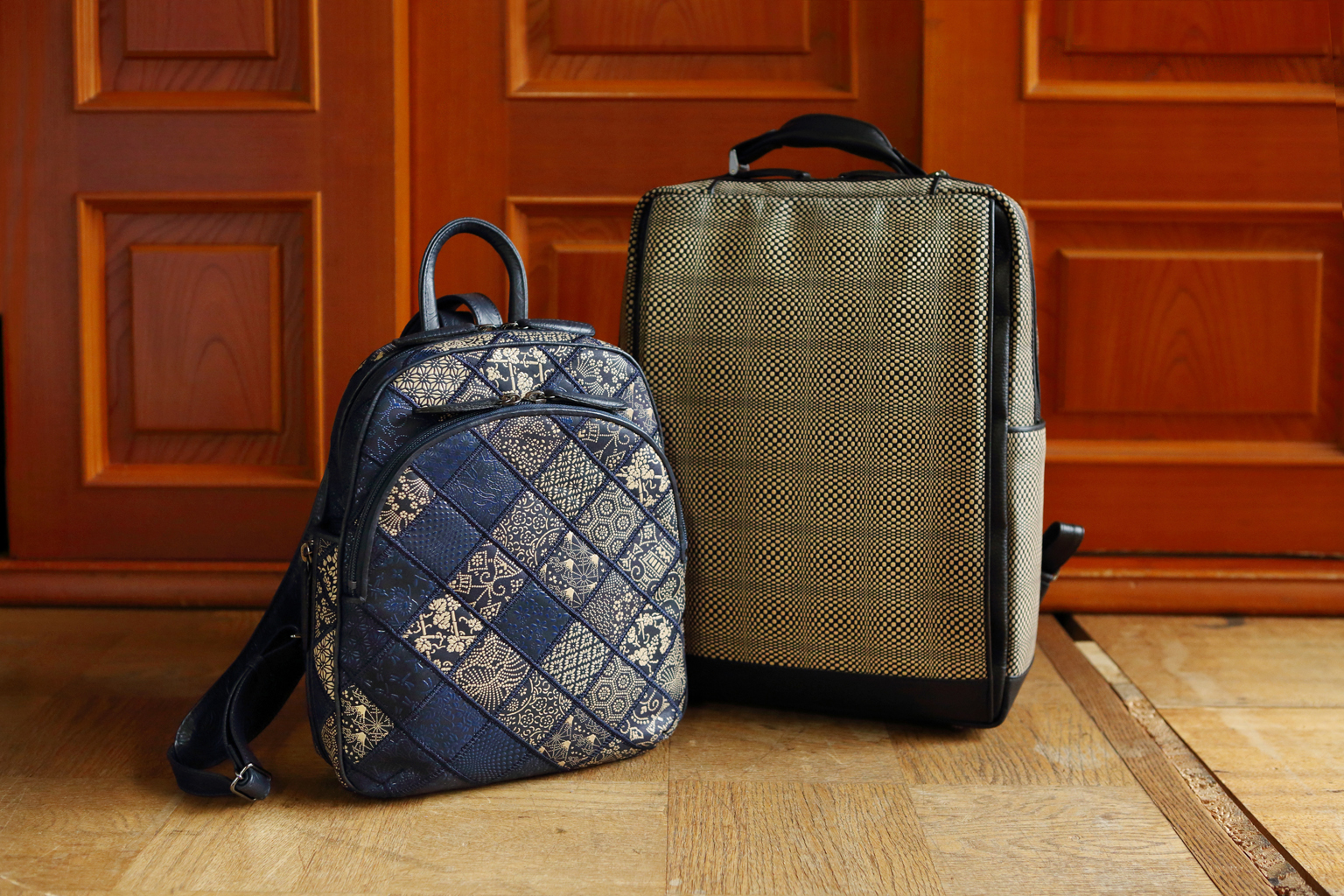
A corded patchwork inden backpack (left) and a backpack featuring variable ichimatsu-check inden as the main motif (right). Their well-built quality stands out, with attention to usability down to the details, such as side storage and convenient inner pockets.
Looking Toward New Challenges from Sanko’s Home in Edogawa City
Matsumoto, Edogawa City, where Sanko’s workshop is located, is the place where Tada has lived and continued his craft for about 60 years. In December 2025, Sanko was selected as an Outstanding Company in the Edogawa City Industrial Awards. Edogawa City, Tada says, holds the history of both his work and his family.
“In the past, there were lots of sewing businesses around here, so the whole area had a spirit of supporting making things together. It’s tough to set up a workshop with this much equipment in the city center. I’m truly grateful that, because this is Edogawa City, we were able to keep going as a family, working together.”
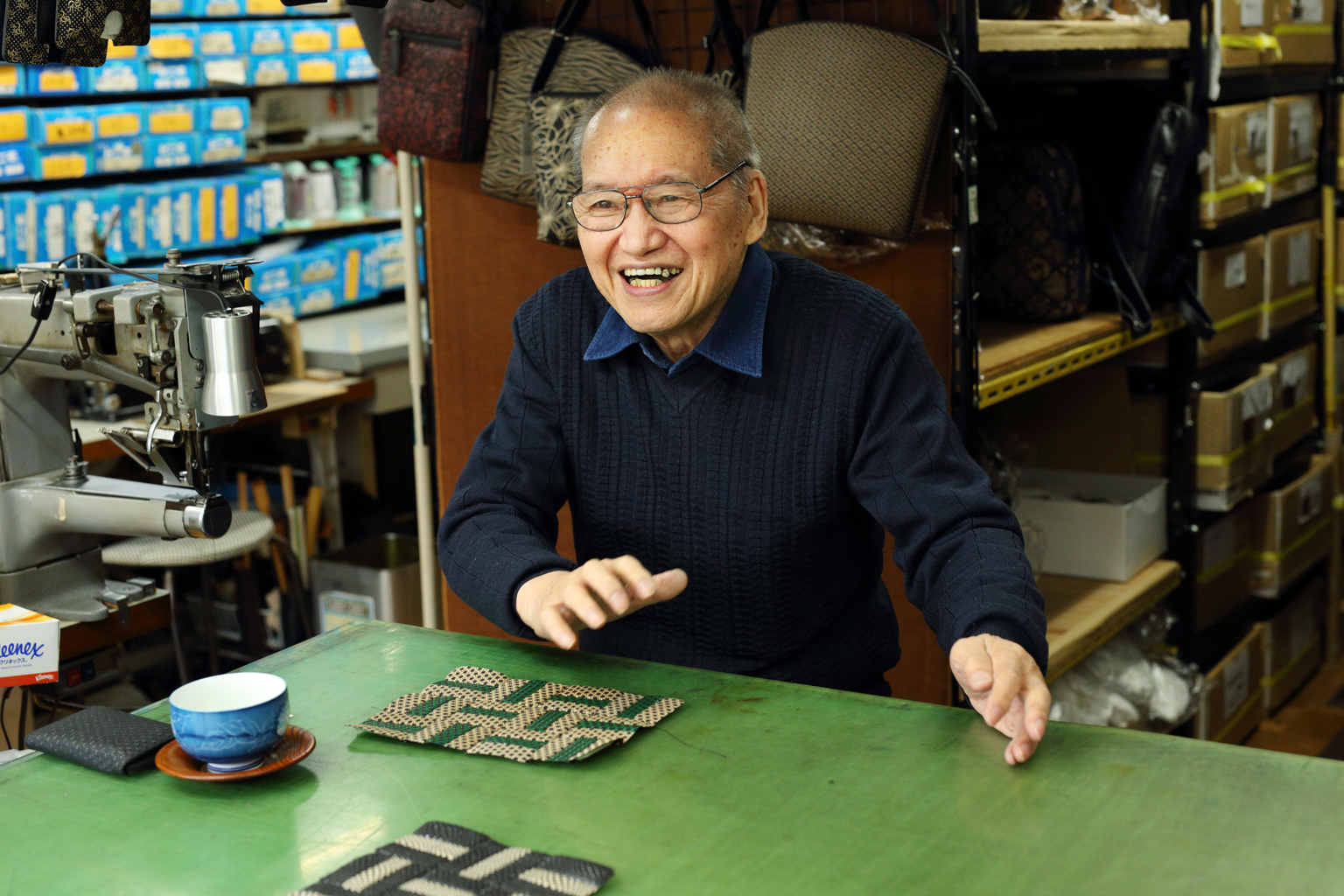
“When we were producing brand-name bags, Edogawa City even helped us look for part-time staff,” Tada recalls with nostalgia.
Now in his 80s, Tada’s passion for making things has never run dry. He watches his grandchild’s randoseru school bag and improves the structure of backpack shoulder straps. On the train, he looks at other passengers’ bags and thinks, “That pocket looks convenient.” He absorbs ideas from every part of daily life—and when inspiration strikes, he skips the step of drawing plans and starts cutting patterns immediately.
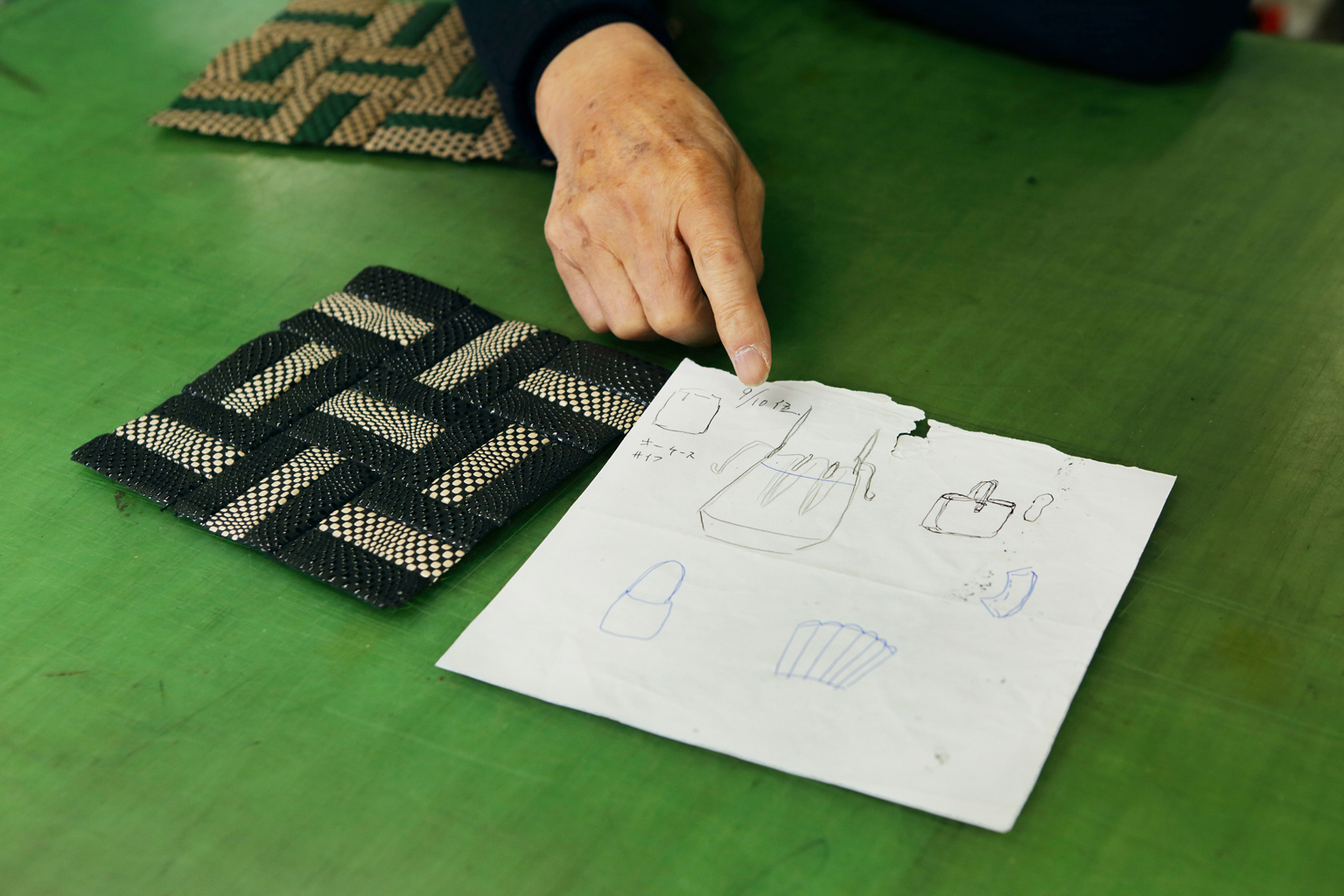
Tada apparently sketches ideas onto whatever paper is nearby the moment they come. “As long as I can roughly predict what kind of bag it will become, I can cut the pattern. I’ve been doing this for decades,” says Tada.
The inden process of applying lacquer patterns to deerskin is usually outsourced to specialized artisans, but after turning 70, Tada set up a workspace in his garage and began studying lacquer himself. “Even if you outsource, if you don’t have your own ‘standards’ inside you, you can’t truly make good things,” he says, his eyes shining with enjoyment.
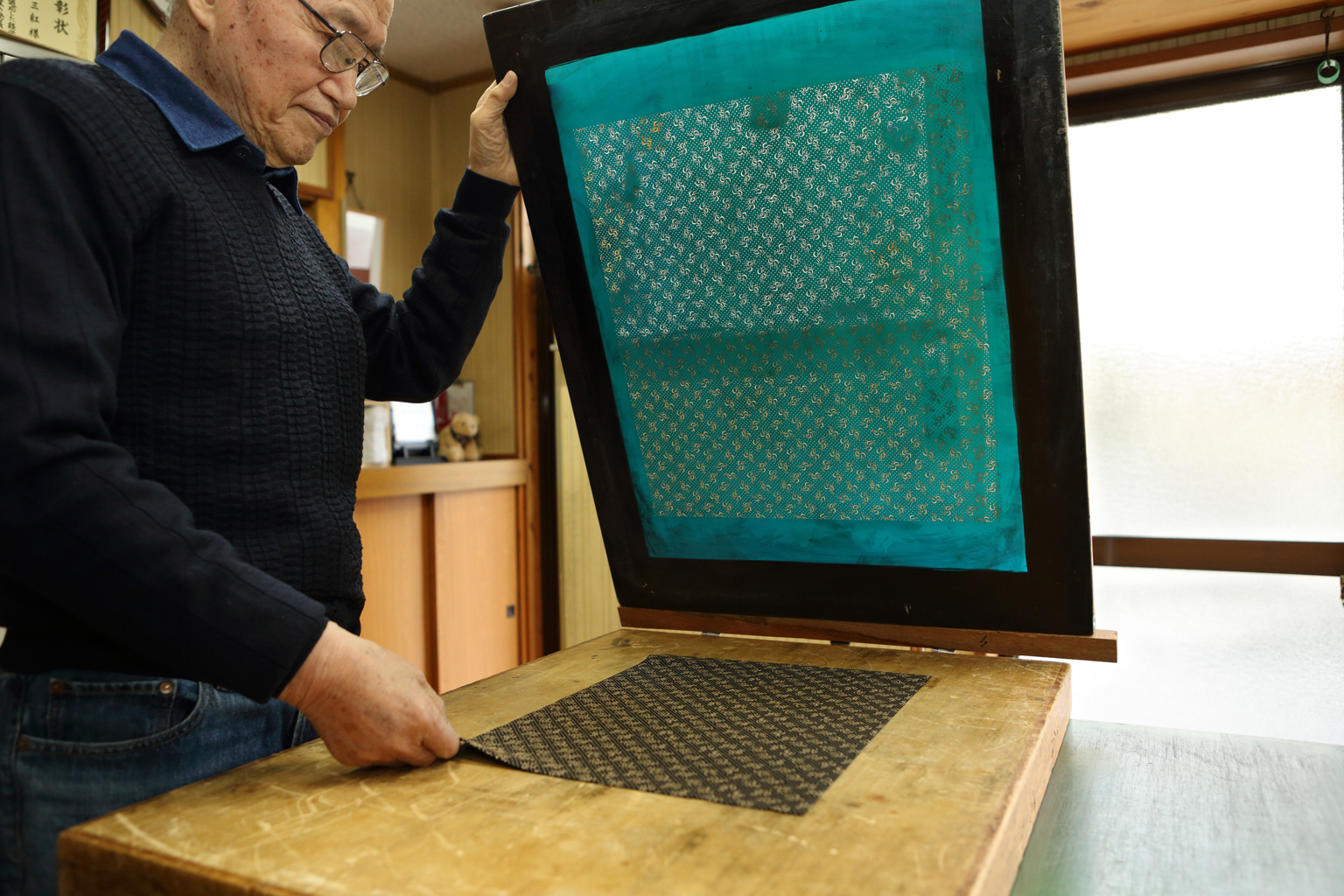
“On Awaji Island where I was born, there’s a saying that if you use lacquerware to bathe a newborn, you won’t develop a lacquer rash. My family is sensitive to raw lacquer, but I don’t react at all—so maybe it was thanks to that first bath,” Tada says with a laugh.
We asked Tada, still tirelessly in pursuit of his craft, about his dreams for the future.
“I’d be happy if we could spread the appeal of inden to overseas customers as well, and have them use Sanko’s bags. And if I get the chance, I’d like to try launching a casual bag brand using offcuts and the like, rather than only making high-end inden bags. I’ve spent my life making bags—so at the end, I want to see this one big flower bloom, don’t I?”
Preserving tradition while continually creating new value—this joyful, forward-moving approach to making things may be the power that supports Edo Sanko Inden as it blossoms from Edogawa to the rest of Japan.
Writing: Kiuchi Aki
Photo: Takeshita Akiko
Introduction of the Artisan
Founded in 1968 by bag artisan Tada Tsukasa. The company continues to create its own bags and accessories by fusing the precise tsunagihagi (joining) techniques refined through reptile leather with the traditional inden craft. Tada himself handles planning, design, and production. Completed in 2000, the technique of corded patchwork inden has become the company’s signature. In 2025, the company was selected as an Outstanding Company in the Edogawa City Industrial Awards.
・Sanko Corporation
・2-35-22 Matsumoto, Edogawa City, Tokyo